Example numbers shown. Tap a box to type your own.
Full breakdown
| Winnings reported as income | |
| Losses | |
| Loss deduction allowed (90% rule) | |
| Federal tax on your winnings | |
| State tax estimate | |
| Total tax | |
| Extra tax from the 90% rule | |
| Net after losses and tax |
Estimated with the 2026 federal brackets. The loss deduction is the smaller of 90% of losses or your winnings, and it only counts if you itemize. State tax is a flat rate on the winnings.
Estimate for education only, not tax advice.
Key takeaways
- Winnings are reported in full as income. You cannot subtract losses first and report only the difference.
- Losses help only if you itemize, and from 2026 the deduction is the smaller of 90% of your losses or your winnings.
- A break-even year is no longer tax-free: win $5,000 and lose $5,000 and $500 stays taxable.
- For 2026 a Form W-2G is triggered at $2,000 for slots, bingo and keno, and at $2,000 plus 300-to-1 odds for most other wagers.
- No W-2G does not mean no tax — the IRS still expects every win on your return, backed by a diary of dates, places and amounts.
How gambling winnings are taxed
The IRS treats a gambling win the same way it treats a paycheck: it is ordinary income. Casino payouts, sportsbook wins, poker cashes, raffle and sweepstakes prizes, and game show winnings all go on Schedule 1 of your return, in full, stacked on top of whatever else you earned. A prize that is not cash — a car, a trip, a boat — counts at its fair market value, which catches people out when the tax bill arrives in cash they never received.
The part most people get wrong is the losses. You may not net them against the winnings and report the difference. Winnings go in as income; losses, if they qualify at all, come off later as an itemized deduction on Schedule A, and only up to the amount you won. If you take the standard deduction — $16,100 for a single filer and $32,200 for a joint return in 2026 — the losses are worth exactly nothing, however large they were.
When a casino or sportsbook keeps 24% of a big win, that is not the tax. It is a prepayment, like the withholding on a paycheck. Your real bill is settled at your marginal rate when you file, so a modest win can produce a refund of part of that 24%, while a very large one can leave a balance still owing.
Gambling tax quick facts for 2026
| Item | 2026 rule |
|---|---|
| Where winnings go | Schedule 1 (Form 1040), reported in full — no netting against losses |
| Where losses go | Schedule A, "Other Itemized Deductions" — itemizers only |
| Loss limit | Smaller of 90% of losses or total winnings (new for 2026) |
| Standard deduction | $16,100 single · $32,200 married filing jointly |
| Form W-2G (slots, bingo, keno) | $2,000 or more on a single play or game |
| Form W-2G (poker tournaments) | More than $5,000 after subtracting the buy-in |
| Form W-2G (other wagers) | $2,000 or more and at least 300 times the wager |
| Federal withholding | 24% on winnings over $5,000 (poker tournaments; 300-to-1 wagers) |
| Proof you need | A diary of dates, places and amounts, plus tickets or statements |
The 90% loss rule
Through 2025, a gambler who itemized could deduct losses dollar for dollar up to the amount won. The One Big Beautiful Bill Act rewrote section 165(d) of the tax code: for tax years from 2026, the deduction is 90% of your losses, still capped at your winnings. In plain terms, the allowed deduction is whichever is smaller — 90% of what you lost, or everything you won.
The order of those two steps matters. Because the 90% comes first, losing more than you won does not always wipe the slate clean. It does once losses pass about 111% of winnings (winnings divided by 0.9), because then 90% of the losses still covers the full win. Between break-even and that point, some winnings stay taxable even though the year lost money overall. The disallowed tenth is gone for good — there is no carrying it into next year.
| Winnings | Losses | Deduction, old rule | Deduction, 2026 rule | Winnings still taxable |
|---|---|---|---|---|
| $5,000 | $5,000 | $5,000 | $4,500 | $500 |
| $10,000 | $8,000 | $8,000 | $7,200 | $2,800 |
| $8,000 | $10,000 | $8,000 | $8,000 | $0 |
| $10,000 | $12,000 | $10,000 | $10,000 | $0 |
The change has drawn criticism from poker players and the betting industry, and a repeal bill has passed a House committee vote, but it has not become law. The calculator above applies the 90% rule as enacted and shows the extra tax it causes on its own line, so you can see the cost either way.
Worked example: $10,000 won, $8,000 lost
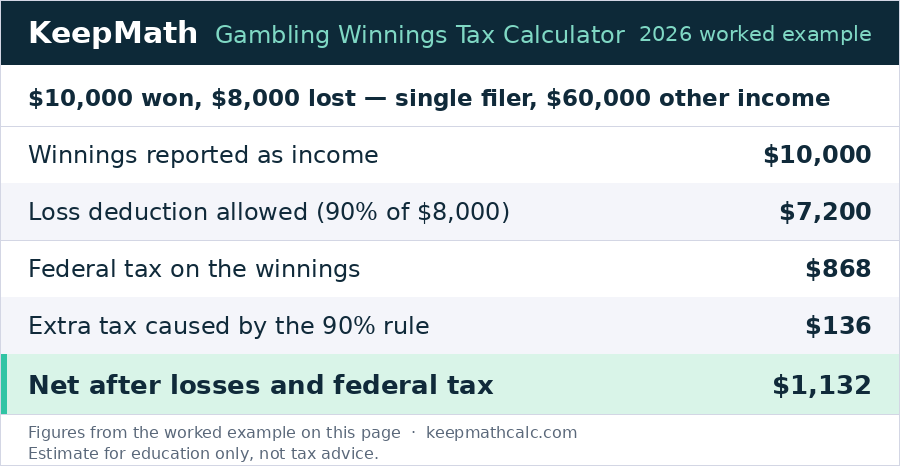
Take a single filer with $60,000 of wages, $12,000 of other itemized deductions (mortgage interest and state tax, say), who wins $10,000 across the year and loses $8,000. Here is the return, step by step.
| Step | Amount |
|---|---|
| Winnings reported as income | $10,000 |
| Losses | $8,000 |
| Loss deduction: 90% × $8,000 (under the $10,000 cap) | $7,200 |
| Other itemized deductions | $12,000 |
| Total itemized — beats the $16,100 standard deduction | $19,200 |
| Taxable income: $60,000 + $10,000 − $19,200 | $50,800 |
| Federal tax on $50,800 (2026 single brackets) | $5,888 |
| Federal tax with no gambling ($43,900 taxable) | $5,020 |
| Federal tax caused by the gambling | $868 |
| The same figure under the old 100% rule | $732 |
| Extra tax from the 90% rule | $136 |
| Net after losses and federal tax | $1,132 |
Two things are worth noticing. First, the deduction only worked because the $12,000 of other itemized deductions pushed the total past the standard deduction; with none, the $7,200 would have saved nothing and the gambling tax would have been higher. Second, the $800 that the 90% rule disallowed ($8,000 of losses minus the $7,200 allowed) was taxed at 17% on the margin here — part at 12%, part at 22% as it crossed a bracket line — which is where the extra $136 comes from.
When you get a Form W-2G
A W-2G is the payer's report to you and the IRS, not a tax bill and not permission to ignore smaller wins. For payments made in 2026 the dollar thresholds rose for the first time in decades, from the old $600 / $1,200 / $1,500 figures to a flat $2,000 for most games, with the 300-to-1 odds test unchanged where it applies.
| Type of win | You get a W-2G in 2026 when… |
|---|---|
| Slot machines | a single payout is $2,000 or more, counted gross before subtracting your bet |
| Bingo | a single game pays $2,000 or more, counted gross |
| Keno | a single game pays $2,000 or more after subtracting the ticket cost |
| Poker tournaments | you win more than $5,000 after subtracting the buy-in |
| Horse and dog racing, jai alai | winnings are $2,000 or more and at least 300 times the wager |
| Sports betting and other wagers | winnings are $2,000 or more and at least 300 times the wager |
| Lotteries, sweepstakes, raffles | winnings are $2,000 or more and at least 300 times the wager |
Separate from reporting, the payer must withhold 24% federal tax on winnings over $5,000 — for poker tournaments, and for racing, lottery and similar wagers that also clear the 300-to-1 test. Slots, bingo and keno have no regular withholding, though a casino can apply 24% backup withholding if you will not provide a taxpayer ID number. Either way, the absence of a form changes nothing about what you owe: every win is income, and the IRS gets a copy of every W-2G that is issued, so the winnings on your return should at least match the forms you received.
The session method for slot play
Counting every spin as a separate bet would bury a slot player in paperwork, so the IRS allows gains and losses from slot play to be measured by the session. In Notice 2015-21 the IRS described a safe harbor for electronically tracked play — the kind recorded through a player's card: a session begins with your first wager on a type of game and ends with your last wager on that same game before the calendar day ends, at one establishment.
Inside a session, wins and losses net to one number. Leave for dinner and come back to the same casino and it is still the same session; walk into a different casino, switch from slots to blackjack, or cross midnight, and a new session starts. What you may not do is net one session against another to reach a yearly figure — winning sessions are income, losing sessions are losses, and the two meet only through the itemized deduction, subject to the 90% limit. The Notice was issued as a proposed safe harbor rather than a final rule, so treat it as the IRS's stated approach, keep the underlying records, and check with a tax professional if your play is large or frequent.
Records the IRS expects
The loss deduction stands or falls on paperwork. IRS Publication 529 asks for a diary that shows, for each wagering activity: the date and type of wager, the name and location of the establishment, the names of anyone who was with you, and the amount won or lost. On top of the diary you need something that backs it up — losing tickets, casino win/loss statements, sportsbook account histories, or the W-2Gs themselves.
In practice, a player's card statement from the casino and a year-end activity report from a sportsbook cover most of this, and they are far stronger evidence than a notebook reconstructed in April. Keep winnings and losses recorded separately, because they enter the return in different places. Without records the IRS can simply disallow the deduction, and the winnings stay taxable in full.
State tax on winnings
States go their own way. Most states with an income tax treat gambling winnings as ordinary income, several — including states with big casino industries — allow no deduction for losses at all, and a few have no income tax to begin with. Some states also require withholding on large in-state wins, and winnings from a casino in another state can be taxable both there and at home, usually with a credit for the tax paid to the other state.
The calculator applies the rate you enter to the full winnings, which matches how many states work, but treat it as a rough guide: if your state allows a loss deduction, your real state bill will be lower, and if it does not, the flat rate on gross winnings is about right.
Gambling tax questions
How much tax is due on gambling winnings?
There is no special gambling rate. Winnings are added to your other income and taxed at the same 2026 rates as wages — 10% up to 37% — with most states charging their own tax as well. What you finally owe depends on your total income, your filing status and whether your losses survive as an itemized deduction.
Can I deduct gambling losses if I take the standard deduction?
No. Losses sit on Schedule A as an itemized deduction, so they only help when your itemized total beats the standard deduction — $16,100 single or $32,200 joint in 2026. Plenty of casual players lose the deduction entirely for this reason.
How does the 90% rule work in 2026?
Take 90% of your losses first, then cap that figure at your winnings. Win $10,000 and lose $8,000 and the deduction is $7,200. Lose more than you won and the cap can still cover every dollar: win $8,000, lose $10,000, and 90% of the losses is $9,000, trimmed to the $8,000 you won.
Do I owe tax if I broke even?
Yes, that is the sting of the new rule. Win $5,000 and lose $5,000 and only $4,500 comes off, leaving $500 of income on a year that made you nothing. The missing tenth cannot be carried into a later year either.
Are gambling winnings taxed at a flat 24%?
No. The 24% a casino or sportsbook holds back on a large win is a prepayment toward your bill, not the bill itself. Your real rate is whatever bracket the winnings land in, which can be well under 24% on a modest win or up to 37% on a big one.
What is the session method for slot machines?
Instead of treating every spin as its own bet, you add up one session — one type of game, at one casino, inside one calendar day — and record a single gain or loss for it. The IRS described this safe harbor for electronically tracked slot play in Notice 2015-21. Sessions are never netted against each other.
Do I report winnings if I never got a W-2G?
Yes. The form only tells you what the payer reported; it does not decide what is taxable. Every win belongs on Schedule 1, including small ones no casino ever paperworked.
Are game show and sweepstakes prizes taxable?
Yes. Cash prizes are income, and a car, trip or other prize counts at its fair market value. If a prize is worth more than you can cover with the tax bill, that is worth knowing before you accept it.
Which states tax gambling winnings?
Most states with an income tax treat winnings as regular income, and some refuse any deduction for losses at all. A handful of states have no income tax. Enter your state rate in the calculator to see the combined hit.
How this page was checked
The federal figures were recomputed bracket by bracket for single and joint filers, including the worked example above, using the 2026 brackets and standard deduction in IRS Revenue Procedure 2025-32. The 90% limit follows section 165(d) as rewritten by the One Big Beautiful Bill Act, and the W-2G thresholds follow the IRS Instructions for Forms W-2G and 5754 (January 2026).
Sources and review
Reviewed in November 2026. The brackets and standard deduction used here come from IRS Revenue Procedure 2025-32. The wagering-loss limit follows section 165(d) of the Internal Revenue Code as amended for tax years from 2026.
Other calculators to try
- Lottery tax calculator for Powerball, Mega Millions and scratch-off prizes
- Bonus tax calculator to see what you keep from a bonus
- RMD calculator to figure your required minimum distribution
- No tax on tips calculator if you earn tips
- No tax on overtime calculator if you are paid time-and-a-half
See what you keep after tax.
Try another calculator