Example numbers shown. Tap a box to type your own.
Full breakdown
| Prize | |
| Federal income tax | |
| State income tax | |
| Total tax | |
| Effective total tax rate | |
| Federal tax withheld at payout (24%) | |
| Extra federal tax due at filing (or refund) | |
| Top federal bracket reached |
Federal estimate on 2026 brackets. State tax is a flat rate applied to the whole prize. Local taxes, credits and itemized deductions are not included.
Estimate for education only, not tax advice.
Key takeaways
- A prize counts as ordinary income, so 2026 federal rates run from 10% to 37%, with state tax added in most places.
- The lottery holds back 24% of prizes over $5,000 — that rarely settles the bill on a large win, so plan for more at filing time.
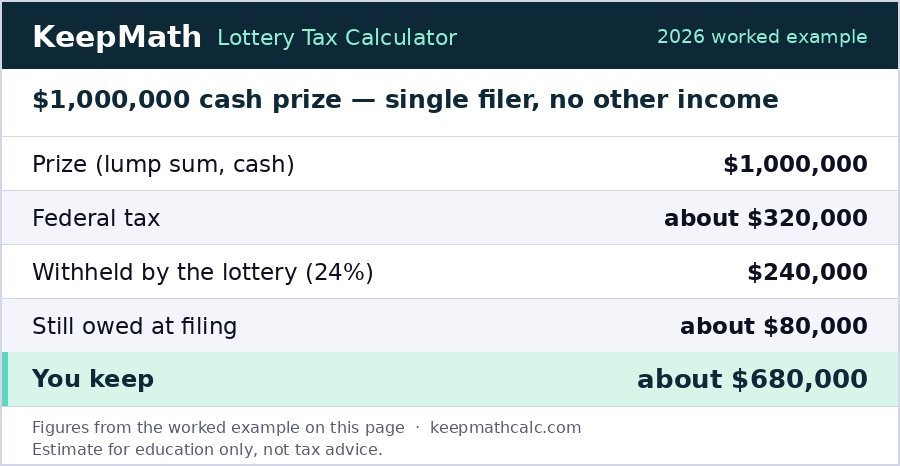
- A single filer with no other income who takes $1 million in cash owes roughly $320,000 federal and ends up with about $680,000 before any state tax.
- A lump sum puts the entire prize into a single tax year; annuity payments are taxed in the years you receive them, which can lower the total federal tax.
- Nine states have no income tax: Alaska, Florida, Nevada, New Hampshire, South Dakota, Tennessee, Texas, Washington and Wyoming.
How lottery winnings are taxed
For federal purposes a lottery prize is just more ordinary income. It stacks on top of your other earnings and is taxed through the 2026 brackets, which climb from 10% to 37%. The top bracket begins at $640,600 of taxable income for single filers and $768,700 for joint filers.
Lottery winnings are subject to federal withholding: on prizes over $5,000, the lottery keeps 24% for the IRS before you are paid and files a Form W-2G. Treat that as a deposit, not the final bill. A big win fills the upper brackets, so the real tax is usually higher and you settle up when you file.
Lottery tax quick facts for 2026
| Item | 2026 figure |
|---|---|
| Amount the lottery holds back from prizes over $5,000 | 24% flat |
| Holdback when no taxpayer ID is provided | 24% |
| Highest bracket | 37%, starting at $640,600 single and $768,700 joint |
| Standard deduction | $16,100 single, $32,200 joint |
| Reporting form | W-2G |
| Losses | Only itemizers, capped at winnings, and just 90% of losses count from 2026 |
| Annuity shape | 30 payments across 29 years that step up about 5% a year |
Federal tax by prize size, including $1 million and $5,000
Below, federal tax on a cash prize is shown for a single filer and for a joint return, with no other income and no state tax. With nothing else on the return, the standard deduction ($16,100 single, $32,200 joint) absorbs the first slice of the prize, so smaller prizes look cheap here. Enter your other income in the calculator for a truer picture.
| Prize | Held back (24%) | Federal tax, single | Balance at filing, single | Federal tax, joint |
|---|---|---|---|---|
| $7,500 | $1,800 | $0 (0.0%) | $1,800 refund | $0 (0.0%) |
| $40,000 | $9,600 | $2,620 (6.6%) | $6,980 refund | $780 (1.9%) |
| $250,000 | $60,000 | $51,304 (20.5%) | $8,696 refund | $37,468 (15.0%) |
| $2,500,000 | $600,000 | $875,000 (35.0%) | $275,000 | $835,250 (33.4%) |
| $15,000,000 | $3,600,000 | $5,500,000 (36.7%) | $1,900,000 | $5,460,250 (36.4%) |
Taxes on $1 million in lottery winnings
Take a $1,000,000 cash prize with no other income. After the $16,100 single standard deduction, $983,900 is taxable, and the 2026 brackets turn that into about $320,000 of federal tax. The lottery already kept $240,000, so roughly $80,000 more is due with the return. What remains is about $680,000, or 68% of the prize. A 5% state tax removes another $50,000, bringing it to roughly $630,000.
Taxes on $2 million in lottery winnings
Take a $2,000,000 cash prize with no other income. After the $16,100 single standard deduction, $1,983,900 is taxable, and the 2026 brackets turn that into about $690,000 of federal tax, or 34.5% of the prize. The lottery already kept $480,000, so roughly $210,000 more is due with the return. What remains is about $1,310,000, or 65.5% of the prize. A 5% state tax removes another $100,000, bringing it to roughly $1,210,000.
Taxes on $5,000 in lottery winnings
Because the 24% holdback starts only above $5,000, a $5,000 prize can be paid out whole, but it is still income. A single filer with $40,000 of other income sits in the 12% bracket, so this prize adds about $600 of tax.
Taxes on $50,000 in lottery winnings
Take a $50,000 prize with no other income. After the $16,100 single standard deduction, $33,900 is taxable and the federal tax is about $3,820. The lottery holds back 24% of a prize over $5,000, which is $12,000 here, so about $8,180 comes back as a refund. If you also earn $40,000 from a job, the same prize adds about $8,350 of tax and the refund shrinks to roughly $3,650. State tax comes on top in most states.
Lump sum or annuity
Big multi-state games such as Powerball and Mega Millions advertise the annuity figure. That annuity is 30 payments spread over 29 years. The cash option is what the lottery has set aside to fund it, and it moves with every drawing, so take the official cash number for your draw rather than assuming a fixed percentage of the jackpot.
Taking cash drops the whole prize into one tax year, so most of it is taxed at 37%. Annuity payments are taxed as they arrive, which means early payments can fall in lower brackets, although a very large jackpot reaches 37% in most years anyway. Here the annuity is modeled as 30 payments growing 5% a year, each taxed separately on 2026 brackets. Brackets will change over three decades, so treat the annuity figure as a guide.
What a jackpot leaves you after tax
Once a prize is large enough, nearly all of it is taxed at the top federal rate, so the share you keep stops changing much. The table uses the cash option for a single filer with no other income, and shows the result with no state tax and with a 5% state rate.
| Cash prize | Federal tax | You keep, no state tax | You keep, 5% state tax |
|---|---|---|---|
| $25 million | $9,200,000 (36.8%) | $15,800,000 | $14,550,000 |
| $50 million | $18,450,000 (36.9%) | $31,550,000 | $29,050,000 |
| $100 million | $36,950,000 (37.0%) | $63,050,000 | $58,050,000 |
| $250 million | $92,450,000 (37.0%) | $157,550,000 | $145,050,000 |
| $500 million | $184,950,000 (37.0%) | $315,050,000 | $290,050,000 |
Read the middle column as a floor for federal tax, since the figures assume the standard deduction and nothing else. A married couple filing jointly gets wider brackets, which lowers the bill slightly on a smaller prize but changes very little on a large one.
Cash or annuity: a side-by-side example
Take a jackpot advertised at $100 million as an annuity. The cash option for a jackpot like that is often about half, so assume $50 million for this illustration. Your actual cash figure will differ.
| Cash option ($50 million) | Annuity ($100 million over 30 years) | |
|---|---|---|
| Federal tax | $18,450,000 | $35,500,008 in total |
| Left after federal tax | $31,550,000 | $64,499,992 in total |
| How it arrives | One payment | First payment about $1,505,144, last about $6,195,375 |
The annuity pays more in total, but it is paid out over 29 years. This comparison ignores inflation and what you could earn by investing the cash, and either of those can change which option comes out ahead. A tax professional can help you weigh them for your own situation.
Lottery tax by state (2026)
No two states treat lottery money exactly alike. Nine have no income tax, two more exempt their own lottery prizes, and the rest tax a prize like any other income. For each state, the table shows its highest 2026 rate, which a large prize will probably reach, and what that rate would cost on a $1,000,000 prize. A smaller prize may face a lower bracket. Pick your state in the calculator to load the same rate.
| State | Highest 2026 rate | State tax on a $1,000,000 prize | Good to know |
|---|---|---|---|
| Alabama | 5% | $50,000 | No state lottery sells tickets here. |
| Alaska | 0% | $0 | No state lottery sells tickets here. |
| Arizona | 2.5% | $25,000 | - |
| Arkansas | 3.9% | $39,000 | - |
| California | 13.3% | $0 on its own lottery prizes | Does not tax California Lottery prizes, which covers Powerball and Mega Millions sold there. |
| Colorado | 4.4% | $44,000 | - |
| Connecticut | 6.99% | $69,900 | - |
| Delaware | 6.6% | $66,000 | - |
| District of Columbia | 10.75% | $107,500 | - |
| Florida | 0% | $0 | No income tax on wages or prizes. |
| Georgia | 5.19% | $51,900 | - |
| Hawaii | 11% | $110,000 | No state lottery sells tickets here. |
| Idaho | 5.3% | $53,000 | - |
| Illinois | 4.95% | $49,500 | - |
| Indiana | 2.95% | $29,500 | - |
| Iowa | 3.8% | $38,000 | - |
| Kansas | 5.58% | $55,800 | - |
| Kentucky | 3.5% | $35,000 | - |
| Louisiana | 3% | $30,000 | - |
| Maine | 7.15% | $71,500 | - |
| Maryland | 6.5% | $65,000 | Counties add their own income tax on top of the state rate. |
| Massachusetts | 9% | $90,000 | 9% includes a 4% surtax on income above about $1 million. Most income is taxed at 5%. |
| Michigan | 4.25% | $42,500 | - |
| Minnesota | 9.85% | $98,500 | - |
| Mississippi | 4% | $40,000 | - |
| Missouri | 4.7% | $47,000 | - |
| Montana | 5.65% | $56,500 | - |
| Nebraska | 4.55% | $45,500 | - |
| Nevada | 0% | $0 | No state lottery sells tickets here. |
| New Hampshire | 0% | $0 | No income tax on wages or prizes. |
| New Jersey | 10.75% | $107,500 | - |
| New Mexico | 5.9% | $59,000 | - |
| New York | 10.9% | $109,000 | New York City and Yonkers residents may owe local tax as well. |
| North Carolina | 3.99% | $39,900 | - |
| North Dakota | 2.5% | $25,000 | - |
| Ohio | 2.75% | $27,500 | - |
| Oklahoma | 4.5% | $45,000 | - |
| Oregon | 9.9% | $99,000 | Some Portland-area residents may owe local income taxes as well. |
| Pennsylvania | 3.07% | $30,700 | Cash prizes taxed at 3.07% since 2016. Noncash prizes are exempt. |
| Rhode Island | 5.99% | $59,900 | - |
| South Carolina | 6% | $60,000 | - |
| South Dakota | 0% | $0 | No income tax on wages or prizes. |
| Tennessee | 0% | $0 | No income tax on wages or prizes. |
| Texas | 0% | $0 | No income tax on wages or prizes. |
| Utah | 4.5% | $45,000 | No state lottery sells tickets here. |
| Vermont | 8.75% | $87,500 | - |
| Virginia | 5.75% | $57,500 | - |
| Washington | 0% | $0 | No tax on wages or lottery prizes. Only high capital gains are taxed. |
| West Virginia | 4.82% | $48,200 | - |
| Wisconsin | 7.65% | $76,500 | - |
| Wyoming | 0% | $0 | No income tax on wages or prizes. |
Rates are taken from the Tax Foundation's 2026 state income tax data. City and county taxes are left out, and states revise their rules, so confirm with your state lottery or revenue agency.
Winning in one state and living in another
Buying a ticket outside your home state can bring two tax claims on the same prize. Your home state typically credits what you paid the ticket state, so you are not taxed in full twice, but you may end up at the higher of the two rates. The calculator accepts a single state rate, so in this case enter the higher one or consult a tax professional.
Other prizes: sweepstakes, game shows and gambling winnings
Cash and prizes from sweepstakes, contests and game shows are taxable income too. A prize that isn't cash, such as a car or a trip, counts at its fair market value, so you can owe tax on something you can't spend. Casino, sports betting and poker winnings are income as well, and the payer reports larger wins to you and the IRS on Form W-2G. The dollar limits for that form depend on the game.
This calculator is built for lottery prizes, but it uses the same 2026 federal brackets, so it gives a rough idea of the tax on a one-time cash win of any kind. Your losses may be deductible if you itemize. See the next section.
Can I deduct gambling losses?
You need to itemize, and the deduction can never exceed what you won. Money spent on losing tickets can count if you kept records. From 2026 the allowed amount is capped at 90% of your losses. The rules are technical, so verify the current treatment with the IRS or a tax professional. A bill to restore the full deduction has moved through a House committee, but it had not become law at the time of this update, so check the IRS for the current rule.
What to do before you claim
- Check the deadline and anonymity rules. Read your lottery's claim deadline and rules. Some states let winners stay anonymous and others do not.
- Decide cash or annuity with advice. Talk to a tax professional before picking cash or annuity. The choice is often final, and the window to decide is commonly around 60 days, though it differs by game and state. Many winners also talk to financial advisors before choosing, since the decision affects decades of income.
- Set money aside for April. Put money aside for the April balance. The 24% held back will not cover a large prize, and underpaying can add a penalty.
- Split a group win properly. For a group win, each member is taxed on their own share, and the group generally files Form 5754 so the lottery can report who gets what.
Lottery tax questions
How much tax do you pay on lottery winnings?
Federal tax follows the ordinary income brackets for 2026, which run from 10% to 37%, and most states add their own tax. The lottery keeps 24% of prizes over $5,000 for the IRS, and the real total is settled on your return.
How much tax do you pay on $1 million in lottery winnings?
For a single filer with no other income taking $1 million in cash, federal tax comes to roughly $320,000, which leaves about $680,000 before any state tax. The lottery would have held $240,000, so around $80,000 is still owed at filing.
How much tax do you pay on $5,000 in lottery winnings?
The 24% holdback applies only to prizes above $5,000, so a $5,000 prize may arrive in full. It is still taxable. A single filer in the 12% bracket would owe about $600 on it.
Is the 24% withholding the final federal tax?
No. It works like a deposit. On a big prize most of the money lands in the 35% and 37% brackets, so your final tax liability is higher than the amount withheld, and the balance is due when you file your tax return.
What is the federal tax rate on lottery winnings in 2025 and 2026?
There is no single rate. Lottery winnings are ordinary income, so the federal tax follows the same seven brackets, from 10% to 37%, in both years. The lottery holds back 24% of a prize over $5,000, but that is only a down payment. The income limits of each bracket moved a little between 2025 and 2026, so this calculator, which uses 2026 figures, is a close estimate for a 2025 win.
How much tax do you pay on $2 million in lottery winnings?
For a single filer with no other income, about $690,000 in federal tax, or 34.5% of the prize, before state tax. The lottery keeps $480,000 up front, so about $210,000 more is due at filing. That leaves roughly $1,310,000, and a 5% state tax would take about $100,000 of it.
How much tax do you pay on $50,000 in lottery winnings?
For a single filer with no other income, about $3,820 in federal tax. The lottery holds back $12,000 (24%), so about $8,180 comes back as a refund. With $40,000 of other income the prize adds about $8,350 of tax instead. State tax comes on top in most states.
Is there a lotto tax calculator?
Yes. This calculator works for Powerball, Mega Millions, state lotto games and scratch-off prizes. Enter the prize, your state and your filing status, and it shows the federal and state tax for a lump sum or an annuity.
Do I owe tax on a small scratch-off prize?
Yes, in principle. All lottery winnings are taxable income, even a small prize. Federal tax is held back only on prizes over $5,000, and each lottery has its own rules for what it reports, but a small prize you were not taxed on up front is still income on your return.
Is the lump sum or the annuity taxed less?
Annuity payments are taxed in the years you receive them, which can lower the total federal tax, although a very large jackpot still reaches the 37% bracket in most years. A lump sum puts the entire prize into a single tax year.
Which states do not tax lottery winnings?
Nine states have no income tax: Alaska, Florida, Nevada, New Hampshire, South Dakota, Tennessee, Texas, Washington and Wyoming. California leaves its own lottery prizes untaxed. Pennsylvania taxes cash prizes from its own lottery at 3.07%.
Do I pay tax in my home state if I bought the ticket in another?
Both can claim a share. The state that sold the ticket may tax the prize and so may your home state, which usually offers a credit for what you paid the other state.
What is the Oregon lottery tax?
Oregon treats lottery prizes as regular income taxed at up to 9.9%, and a large prize reaches that top rate. Choose Oregon in the calculator to load it.
Can I deduct gambling losses against lottery winnings?
Only if you itemize, and never more than your winnings. Beginning in 2026 only 90% of losses count. Check the current rule with the IRS or a tax professional.
Is there a gambling winnings tax calculator?
Yes — use this calculator. Casino, sports betting and poker winnings are ordinary income, just like lottery winnings, so enter the prize, your state and your filing status and it works the same way. Sweepstakes, contest and game-show prizes count too, at their fair market value when the prize is not cash. One difference: gambling losses can only be deducted if you itemize, and from 2026 only 90% of losses count.
Is there a lottery tax calculator by state?
Yes. Choose your state above and the calculator loads its top 2026 income tax rate, which you can edit if your prize is small or your state handles lottery prizes differently.
Is the tax the same on Powerball and Mega Millions?
The federal rules are the same for both: the prize is ordinary income, 24% is withheld on prizes above $5,000, and the final tax is settled on your return. What differs is the state, because the state where the ticket was sold and the state where you live can each have their own rules.
What is the cash value of a lottery jackpot?
The big number on the billboard isn't cash in a vault — it's the annuity total, the full amount paid out over 30 years in graduated payments. The cash value (lump sum) is what the lottery actually holds today: roughly 45–60% of the advertised jackpot, typically about half. The exact share moves with interest rates. And either way, federal tax still applies on top — 24% withheld up front, up to 37% owed when you file.
How this page was checked
Federal results were compared with a separate bracket-by-bracket calculation for single and joint filers, including the annuity case. State rates come from the Tax Foundation's 2026 table, and the filing figures from IRS Revenue Procedure 2025-32.
Sources and review
Last reviewed November 2026. Federal brackets and the standard deduction follow IRS Revenue Procedure 2025-32. State rates follow the Tax Foundation's 2026 data.
Other calculators to try
- RSU tax calculator for another large taxable payout
- Bonus tax calculator to see what you keep from a bonus
- RMD calculator to figure your required minimum distribution
- No tax on tips calculator if you earn tips
- No tax on overtime calculator if you are paid time-and-a-half
See what you keep after tax.
Try another calculator