Example numbers shown. Tap a box to type your own.
Full breakdown
| Net profit | |
| Net earnings subject to tax (92.35%) | |
| Social Security (12.4%) | |
| Medicare (2.9%) | |
| Additional Medicare (0.9%) | |
| Self-employment tax | |
| Deductible half of self-employment tax | |
| Standard deduction | |
| Taxable income after deductions | |
| Federal income tax on your 1099 income | |
| Share of net profit | |
| Set aside per quarter |
Federal tax only. State tax, credits and the qualified business income deduction are not included.
Estimate for education only, not tax advice.
Key takeaways
- Self-employment tax: 15.3% of 92.35% of your net profit. That is 12.4% for Social Security (up to $184,500 of earnings in 2026) plus 2.9% for Medicare.
- Income tax: charged on top, at your normal bracket rates, after the standard deduction and half of the self-employment tax come off.
- The filing line: net earnings of $400 or more mean self-employment tax is due.
- Payments: nobody withholds tax from a 1099, so most people pay in four installments.
- The 1099 tax rate: there is no single rate. Expect self-employment tax of about 14.1% of your profit, plus income tax at 10% to 37% on top. For a single filer with no other income, that comes to roughly 15% of profit at $20,000 and 29% at $150,000.
What this calculator estimates
You enter your 1099 income, your business expenses and your filing status. The calculator subtracts the expenses to get net profit, then adds two layers of federal tax: self-employment tax and income tax. If you also have a W-2 job, add the wages. The income tax shown is the extra tax your 1099 work creates on top of what your wages would owe anyway.
The income tax step uses the standard deduction for your filing status and takes off the deductible half of self-employment tax. It leaves out credits, other income, itemized deductions, the qualified business income deduction and state tax, so the real figure on your return can be lower.
How much tax do I pay on 1099 income?
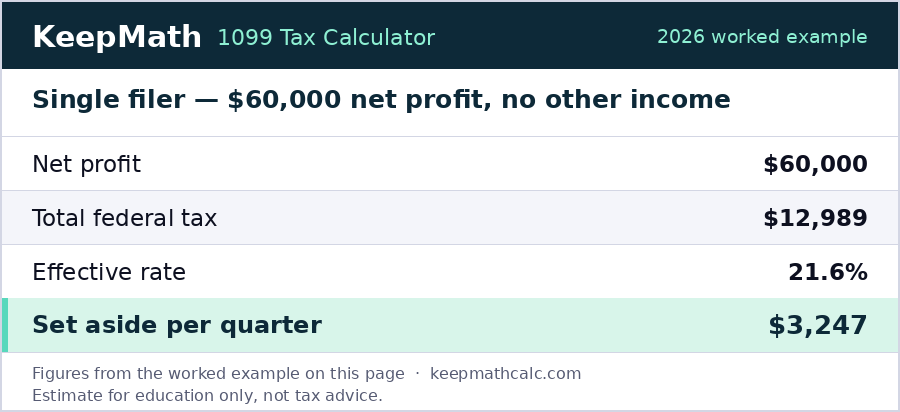
For a single filer with no other income, federal tax runs from about 15% of net profit at $20,000 to about 29% at $150,000, and the share grows as profit grows. Roughly 14.1% of profit is self-employment tax (15.3% of 92.35% of it), and income tax sits on top. Take $60,000 of profit as an example: a single filer with no other income owes about $12,989, which is 21.6% of the profit or $3,247 a quarter, before any state tax.
Two words matter in that answer. First, profit: your expenses come off before either tax is figured, so tracking them honestly is the cheapest way to lower the bill. Second, "about": the 20% QBI deduction, self-employed health insurance and a SEP IRA contribution can bring income tax down further, and this calculator leaves them out on purpose. See the 1099 tax calculator with deductions section below for which ones to look into, or the complete 1099 tax guide for the full picture.
Filing for an earlier year? The 15.3% rate and the 92.35% rule did not change. What moves is the Social Security cap ($176,100 for 2025, $168,600 for 2024), plus the brackets and the standard deduction, so this page's 2026 numbers will only be a rough guide for an older return.
How 1099 income is taxed
Freelance and contractor income is hit by two separate taxes. They use different rules, which is why a single flat percentage rarely fits.
| Layer | What it pays for | How it is figured |
|---|---|---|
| Self-employment tax | Social Security and Medicare | 15.3% of 92.35% of net profit, with Social Security stopping at $184,500 |
| Federal income tax | General government spending | Bracket rates applied to taxable income after deductions |
Why half of the self-employment tax comes off
You pay both the employer and the employee share of Social Security and Medicare. The tax code lets you deduct the employer-equivalent half when you work out income tax. That deduction lowers your income tax but not the self-employment tax itself.
1099 tax rate and tax brackets for 2026
There is no single 1099 tax rate, because a 1099 payment is taxed in two layers. The first is self-employment tax: 15.3% of 92.35% of your net profit, which works out to about 14.1% of profit. The Social Security part (12.4%) stops once your earnings reach $184,500, but the 2.9% Medicare part has no cap. The second layer is regular income tax, which uses the same brackets as everyone else.
The 2026 brackets below apply to taxable income. That is your profit after business expenses, half of the self-employment tax and the standard deduction ($16,100 single, $32,200 married filing jointly).
| Rate | Single | Married filing jointly |
|---|---|---|
| 10% | up to $12,400 | up to $24,800 |
| 12% | $12,401 to $50,400 | $24,801 to $100,800 |
| 22% | $50,401 to $105,700 | $100,801 to $211,400 |
| 24% | $105,701 to $201,775 | $211,401 to $403,550 |
| 32% | $201,776 to $256,225 | $403,551 to $512,450 |
| 35% | $256,226 to $640,600 | $512,451 to $768,700 |
| 37% | over $640,600 | over $768,700 |
Bracket rates apply only to the slice of income inside each band, not to the whole amount. For what the two layers add up to at different profit levels, see the table in the set-aside section below. State tax is not included.
How to calculate self-employment tax by hand
- Work out net profit. Subtract business expenses from your 1099 income to get net profit.
- Find net earnings. Multiply net profit by 0.9235. This is your net earnings.
- Work out Social Security. Multiply by 12.4% for Social Security, but only on earnings up to $184,500 minus any W-2 wages you already have.
- Work out Medicare. Multiply the same net earnings by 2.9% for Medicare, with no cap.
- Add the extra Medicare tax. Add an extra 0.9% Medicare tax on earnings above $200,000 for single and head of household, $250,000 for married filing jointly, or $125,000 for married filing separately. W-2 wages count toward those amounts.
With $60,000 of net profit, net earnings are $55,410. Social Security comes to $6,870.84 and Medicare to $1,606.89, so self-employment tax is $8,477.73. Half of it, $4,238.86, is deductible when you work out income tax.
1099 tax calculator with deductions
Deductions help in two places. Business expenses shrink your net profit, which lowers both self-employment tax and income tax. The standard deduction and the deductible half of self-employment tax only lower income tax. The calculator applies all three.
Expenses to enter in the expenses box
- Software, apps and subscriptions you use for the work.
- Supplies, tools and equipment.
- The business share of your phone and internet bill.
- Advertising, website costs and professional fees.
- Business mileage and vehicle costs, using records you can show.
- A home office, if you meet the IRS rules for one.
- Platform and payment-processing fees.
Deductions that sit outside the expenses box
Self-employed health insurance premiums, contributions to a retirement plan such as a SEP IRA, and the qualified business income deduction can all reduce your income tax further. This calculator does not include them. If they apply to you, your actual income tax will come out lower than the estimate.
The qualified business income (QBI) deduction
On top of the deductions above, most 1099 workers can also deduct up to 20% of their net business income under Section 199A, the qualified business income (QBI) deduction, claimed on Form 8995.
For 2026 the full 20% applies when taxable income is below $201,750 for single filers or $403,500 for married couples filing jointly, and it phases out above those amounts. Like the other deductions here, it lowers income tax only, not the 15.3% self-employment tax, and this calculator does not include it.
Keep receipts and a mileage log, because you may need to show them if the IRS asks.
Worked examples
Every example uses 2026 figures and the standard deduction. Amounts are rounded to the nearest dollar.
Single, $30,000 net profit. Self-employment tax is $4,239 and income tax is $1,178. The total is $5,417, which is 18.1% of profit, or about $1,354 a quarter.
Single, $80,000 net profit. Self-employment tax is $11,304 and income tax is $7,527. The total is $18,830, or 23.5% of profit, about $4,708 a quarter.
Married filing jointly, $60,000 net profit, no other income. Self-employment tax is $8,478 and income tax is $2,356. The total is $10,834, which is 18.1% of profit.
Head of household, $40,000 net profit. Self-employment tax is $5,652 and income tax is $1,302. The total is $6,954, or 17.4% of profit.
Single, $40,000 net profit plus $180,000 of W-2 wages. The job wages use almost all of the Social Security limit, so self-employment tax is only $1,782 including the extra 0.9% Medicare tax. The profit lands in higher income tax brackets, though, adding $9,509 of income tax. The total is $11,291, or 28.2% of the profit.
How much to set aside: your 1099 estimated tax
The share of 1099 income that goes to federal tax rises with profit. This table is for a single filer with no other income and uses the standard deduction. Use it as a 1099 estimated tax calculator: divide the total by four to see what each quarterly payment should be.
| Net profit | Total federal tax | Share of profit | Per quarter |
|---|---|---|---|
| $20,000 | $3,075 | 15.4% | $769 |
| $40,000 | $7,933 | 19.8% | $1,983 |
| $60,000 | $12,989 | 21.6% | $3,247 |
| $80,000 | $18,830 | 23.5% | $4,708 |
| $100,000 | $25,745 | 25.7% | $6,436 |
| $150,000 | $43,385 | 28.9% | $10,846 |
State tax comes on top, so add a margin if your state taxes income.
Quarterly estimated payments
If you expect to owe $1,000 or more for the year after withholding and credits, the IRS generally wants you to pay as you earn. The 2026 installments are due April 15, June 15, September 15 and January 15, 2027. A date moves when it falls on a weekend or holiday, so confirm it with the IRS. You pay with Form 1040-ES or through your IRS online account.
To avoid an underpayment penalty, you generally need to pay the smaller of 90% of this year's tax or 100% of last year's tax. The second figure becomes 110% if last year's adjusted gross income was above $150,000 ($75,000 if married filing separately).
The quarterly number in this calculator is simply the total divided by four. If you have a W-2 job, tax withheld from your paychecks counts toward the total, so your own installments may be smaller.
1099 forms and where the income goes
Clients that paid you as a contractor usually send Form 1099-NEC, and payment apps may send a 1099-K. You owe tax on the income even if a form never arrives. You report the income and expenses on Schedule C, figure self-employment tax on Schedule SE, and carry the results to your Form 1040.
1099 or W-2: the tax differences
To compare the two in dollars, use the W-2 vs 1099 tax calculator.
| W-2 employee | 1099 contractor | |
|---|---|---|
| Social Security and Medicare | You pay half, your employer pays half | You pay both halves |
| Tax withholding | Taken from each paycheck | None, so you make quarterly payments |
| Work expenses | Generally not deductible if unreimbursed | Deducted from income on Schedule C |
| Income form | Form W-2 | Form 1099-NEC or 1099-K |
If you also have a W-2 job
Wages from a job count toward the $184,500 Social Security limit, and they also count toward the income lines for the extra 0.9% Medicare tax. A high W-2 salary can therefore cut your self-employment tax a lot, as the fifth example shows, while your income tax goes up because the 1099 profit is taxed on top of your wages. Use the W-2 and 1099 tax calculator to compare the two side by side.
State taxes on 1099 income
This calculator covers federal tax only. Some states, such as Florida, have no state income tax. Others, including California, tax self-employment income under their own rules. As a rough guide, Illinois taxes income at a flat 4.95%, so $60,000 of net profit means roughly $2,970 of state tax before the state’s own deductions — on top of the $12,989 federal figure above. Check your state revenue department for the current rates and for any local taxes.
Common mistakes
- Applying 15.3% to your whole profit instead of 92.35% of it.
- Entering revenue as profit and forgetting the business expenses.
- Counting only self-employment tax and forgetting the income tax on top of it.
- Leaving out W-2 wages, which change how much Social Security tax is left to pay.
- Skipping the quarterly payments and facing a bill and a penalty in the spring.
Questions
How do I calculate my self-employed taxes?
Subtract your expenses from your income, multiply the profit by 92.35%, and apply 15.3% for self-employment tax. Then work out income tax on your profit after the standard deduction and half of the self-employment tax. The calculator above does all of that.
Are self-employment taxes 30%?
No. Self-employment tax is 15.3% of 92.35% of profit, about 14.1%. With income tax added, the combined federal share runs from roughly 15% to 29% of profit for a single filer between $20,000 and $150,000.
How much tax do I pay on 1099 income?
For a single filer with no other income, about 15% of net profit at $20,000 and about 29% at $150,000 in federal tax. Roughly 14.1% of profit is self-employment tax and income tax comes on top. For example, $60,000 of profit comes to about $12,989, or 21.6%, before state tax. Expenses are subtracted first, so enter them in the calculator.
What is the tax rate on 1099 income?
There is no single rate. 1099 income is hit by self-employment tax of about 14.1% of your profit, plus federal income tax at 10% to 37% depending on your taxable income. The bracket table on this page shows the 2026 bands.
What can I write off on a 1099?
Ordinary and necessary business costs: software, supplies and equipment, the business share of your phone and internet, advertising, professional fees and business mileage. They are subtracted from your income before both self-employment tax and income tax, so enter them in the expenses box.
Is unemployment income (Form 1099-G) taxable?
Yes. Unemployment benefits are taxable federal income and are reported on Form 1099-G. They are not self-employment income, so no self-employment tax applies. They are taxed at your normal bracket rates, and many state agencies let you ask for 10% federal tax to be withheld when you claim. This calculator is built for self-employment income, so it will not give the right answer for a 1099-G. Some states do not tax unemployment benefits, so check yours.
Is this calculator for Form 1099-R?
No. Form 1099-R reports payouts from retirement accounts such as a 401(k) or an IRA. That money is generally ordinary income with no self-employment tax, and early withdrawals can carry an extra 10% tax. This calculator is built for self-employment income, such as the pay reported on a Form 1099-NEC.
Does this calculator include dependents or tax credits?
No. It does not include the child tax credit or other credits, which lower your tax after it is calculated. If you have children or other credits, your actual tax can be lower than the estimate.
How much tax will I pay on $30,000 of self-employment income?
A single filer with $30,000 of net profit and no other income owes about $4,239 of self-employment tax and $1,178 of income tax, around $5,417 in total, using the 2026 standard deduction.
Do I pay self-employment tax if I make less than $10,000?
Yes, if your net earnings are $400 or more. On $10,000 of net profit, self-employment tax is about $1,413.
How much should I set aside for taxes on a 1099?
Many single filers land between 15% and 29% of profit, depending on how much they earn. Use the calculator for your own number and add a margin for state tax.
Do I owe tax if I never get a 1099?
Yes. Income from self-employment is taxable whether or not a client or app sends a form.
When does a client have to send me a 1099?
For 2026, a client only has to send a Form 1099-NEC when it paid you $2,000 or more in the year — the threshold was $600 before the One Big Beautiful Bill raised it. Payment apps report on Form 1099-K only above $20,000 and 200 transactions. But the form is only paperwork: you owe tax on every dollar you earned, whether or not a form arrives.
Is self-employment tax deductible?
Half of it is deductible when you work out income tax. The extra 0.9% Medicare tax is not.
Does this calculator include state tax?
No. It covers federal self-employment tax and federal income tax only.
Can I use it for a side hustle with a W-2 job?
Yes. Enter your net side income and add your job wages in the optional box so the Social Security limit and bracket stacking are handled.
Is 1099 tax the same as self-employment tax?
No. Self-employment tax pays for Social Security and Medicare. Income tax is a separate layer. A 1099 worker pays both.
Can 1099 workers claim the 20% QBI deduction?
Yes — and it's the biggest tax break most 1099 workers get. If you report your 1099 income on Schedule C, you can usually deduct up to 20% of your net business income under Section 199A (QBI), claimed on Form 8995. You don't need to itemize. For 2026, the full 20% applies when your taxable income is below $201,750 (single) or $403,500 (joint). Above that, the deduction starts phasing out. One catch: it lowers your income tax only — not the 15.3% self-employment tax.
Sources and review
Last reviewed November 2026. Rates and the $184,500 Social Security limit follow IRS and Social Security Administration figures for 2026. Brackets and standard deductions come from IRS Revenue Procedure 2025-32. Check IRS.gov for the latest before you file.
Your next steps as a freelancer
- Set up the habit first: move 20% of every payment into a separate tax account the day it arrives — then run the calculator with your 1099 income, business expenses and filing status to see your self-employment tax, income tax and quarterly set-aside.
- Pay the installments with Form 1040-ES or through your IRS online account.
- Report the income and expenses on Schedule C, figure self-employment tax on Schedule SE, and carry the results to your Form 1040.
More calculators
- Self-employed health insurance deduction calculator to deduct your premiums
- W-2 vs 1099 tax calculator to compare contractor pay with a salary
- Bonus tax calculator to see what you keep from a bonus
- No tax on tips calculator if you also earn tips
- no tax on overtime calculator if you also work overtime
See what you keep after tax.
Try another calculator