Example numbers shown. Tap a box to type your own.
Full breakdown
| Health, dental and vision premiums that count | |
| Long-term care premiums that count | |
| Total eligible premiums | |
| Net profit or S corporation wages | |
| Less half of self-employment tax | |
| Less retirement contribution for yourself | |
| Profit limit | |
| Deduction (the smaller of premiums and limit) | |
| Taxable income without the deduction | |
| Taxable income with the deduction | |
| Federal bracket on the top dollars | |
| Estimated income tax saved |
Federal income tax only. State tax, credits and the qualified business income deduction are not included.
Estimate for education only, not tax advice.
Key takeaways
- Your deduction is whichever is lower: the premiums that qualify or the ceiling set by your profit.
- No itemizing needed — it is an adjustment to income, so you can use it alongside the standard deduction.
- Any month with an open employer-subsidized plan is excluded, whether or not you enrolled.
- It reduces only income tax — self-employment tax is figured first on Schedule SE and does not move.
- Claim it on Form 7206, which then flows to Schedule 1 and your Form 1040.
In one line
Your deduction is whichever is lower: the premiums that qualify or the ceiling set by your profit
Do you pass the four tests?
Read each line and tick it if it describes you. A line you cannot tick shows where to dig before you claim anything.
Tick each statement that applies to you.
Which premiums go in the pot
Goes in
- Health, dental and vision policies covering you, a spouse or dependents.
- Cover for a child who is still under 27 on December 31, dependent or not.
- What you pay yourself for Medicare Parts B and D, Medigap or an Advantage plan.
- Long-term care premiums, trimmed to the limit for the insured person's age.
Stays out
- Any month when a subsidized employer plan was yours for the taking, through your job or your spouse's.
- The slice of a marketplace premium that the advance tax credit already covered.
- Long-term care dollars above the age limit.
- Policies for life or disability income, which are not health coverage.
Where the profit ceiling comes from
A deduction cannot turn your business income into a loss on its own, which is why the IRS ties it to what you earned. Here is the order of operations:
- Start with net profit. Take the profit left after business expenses, from the business that carries your health plan.
- Subtract half of your self-employment tax. Take away half of your self-employment tax, the portion you already get to deduct.
- Subtract your retirement contributions. Take away whatever you contributed to your own SEP, SIMPLE or solo 401(k).
- Take the lower figure. What remains is the ceiling. Your deduction is the lower of that figure and your qualifying premiums.
Retirement contributions are the usual surprise. They come out of the same pool of profit, so a big one leaves less room for premiums.
How the employer plan rule plays out
The IRS looks at one month at a time. Picture a spouse whose job would have covered you from January to June, before you bought a policy of your own. Those six months fall away and the other six stay in.
Example: $9,000 of premiums works out to $750 a month, so only July through December adds up, giving $4,500.
Saying no to the offer does not rescue the month, because the test is whether you were able to join. If your premium changed during the year, type in the amount that matches the months that still count.
Seven scenarios worked through
Numbers use 2026 rules with the standard deduction and are rounded to whole dollars.
| Scenario | Ceiling from profit | Amount deducted | Federal tax saved |
|---|---|---|---|
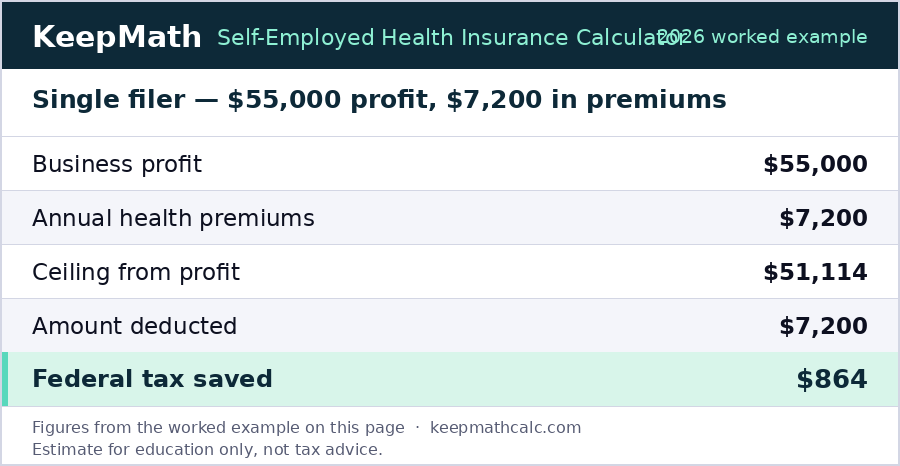
| Single filer, $55,000 profit, $7,200 of premiums | $51,114 | $7,200 | $864 |
| Single, $40,000 profit, $12,000 of premiums, $8,000 contributed to a SEP IRA | $29,174 | $12,000 | $1,213 |
| Married filing jointly, $90,000 profit, $18,000 of family premiums, $10,000 into a solo 401(k) | $73,642 | $18,000 | $2,133 |
| Single, $30,000 profit, $24,000 of premiums, $5,000 contributed to a SEP IRA | $22,881 | $22,881 (capped) | $678 |
| Single, $60,000 profit, $8,400 of premiums, an employer plan open for 4 months | $55,761 | $5,600 | $672 |
| Single, $50,000 profit, $6,000 of health premiums plus $3,000 of long-term care at age 51 to 60 | $46,468 | $7,860 | $943 |
| Single S corporation owner, $70,000 of wages, $9,600 of premiums | $70,000 | $9,600 | $1,502 |
In the fourth scenario, $1,119 of premiums miss the cut because the ceiling is lower. In the sixth, $3,000 of long-term care shrinks to the $1,860 limit.
What each $1,000 is worth
The saving shrinks when profit sits below the standard deduction, since there is little or no income tax left to cut, though your adjusted gross income still falls. For the full tax bill on the same profit, try the 1099 tax calculator.
Special cases
Medicare and long-term care
If you are past 65 and still working for yourself, the Medicare premiums you pay out of pocket can join the pot. Long-term care is limited per insured person, and the 2026 limits rise with age:
| Age at year end | Limit per person |
|---|---|
| 40 or younger | $500 |
| 41 to 50 | $930 |
| 51 to 60 | $1,860 |
| 61 to 70 | $4,960 |
| Over 70 | $6,200 |
Couples should enter each spouse's long-term care premium separately and add the two deductions.
Marketplace plans and Form 1095-A
Use the premium you actually paid after the advance credit, not the full price printed on your 1095-A. Because the deduction lowers income and income drives the credit, the two figures chase each other. Publication 974 walks through the loop.
S corporation owners
With more than 2% of an S corporation, the premium runs through the company: it pays or reimburses you and adds the amount to your W-2 wages in box 1. Social Security and Medicare tax do not apply to that slice, and your personal deduction is capped at the wages the company pays you. Choose the S corporation setting above and type in those wages.
Taking the number to your return
Treat this page as a rough Form 7206 worksheet. The IRS form produces the official amount, which then moves to Schedule 1 and lands on your Form 1040.
The deduction sits above the line, so it works alongside the standard deduction, and it trims the profit that feeds the qualified business income deduction. Premiums above your ceiling can only help as Schedule A medical expenses, which requires itemizing and medical costs beyond 7.5% of your adjusted gross income.
Questions
Who qualifies for the self-employed health insurance deduction?
Anyone running their own business at a profit clears the first test: sole proprietors, single-member LLC owners, partners with self-employment earnings, and S corporation owners with more than 2% of the stock and W-2 wages. The policy must sit under that business, and any month with an open employer-subsidized plan is excluded.
How do I work out my self-employed health insurance deduction?
Total the qualifying premiums, then compute your ceiling by taking net profit and removing half of your self-employment tax and any SEP, SIMPLE or solo 401(k) contribution for yourself. The lower of the two figures is your deduction.
Does this deduction require itemizing?
No. It is an adjustment to income, so you can use it alongside the standard deduction. That is its biggest advantage over claiming premiums as a medical expense.
Do I have to file Form 7206?
Only when you claim the deduction. The form calculates the amount, which then flows to Schedule 1 and your Form 1040.
Will it lower my Social Security and Medicare tax as a freelancer?
No. Self-employment tax is figured first on Schedule SE. This deduction comes later and reduces only income tax.
My spouse's employer offers a plan. Can I still deduct my own premiums?
Only for months when that plan was not available to you. Having the option is enough to disqualify a month, whether or not you enrolled, and the same goes for a plan open to you through your own job or a dependent's.
Do Medicare premiums qualify when I work for myself?
They can, provided you have a business with net profit. Parts B and D, Medigap and Medicare Advantage premiums that you pay yourself are eligible, along with those of a covered spouse or dependents.
How much long-term care insurance can I include?
Each insured person has an age-based ceiling that climbs from $500 for someone 40 or younger to $6,200 for anyone past 70. The full ladder is in the table on this page.
What happens when premiums exceed my business profit?
Your deduction stops at the ceiling. The leftover might still be a Schedule A medical expense, though only if you itemize and total medical costs go beyond 7.5% of adjusted gross income.
How do the premium tax credit and Form 1095-A change things?
Count only what you really paid after the advance credit. If the credit itself shifts with your income, Publication 974 provides a worksheet for solving the two together.
Does the calculator work if I own an S corporation?
Yes. Pick the S corporation setting and enter your W-2 wages as the profit figure. Those wages carry no self-employment tax, so the wages are the ceiling, and the premiums must show in box 1 of your W-2.
Can I also deduct HSA contributions?
Yes, you can stack them. If you have a high-deductible health plan (HDHP), you can deduct HSA contributions on top of your health insurance premiums. For 2026, the limits are $4,400 for self-only coverage and $8,750 for family coverage, plus a $1,000 catch-up if you're 55 or older. Like the premium deduction, HSA contributions are above-the-line — no itemizing needed.
Sources and review
Last reviewed November 7, 2026. The rules follow the IRS instructions for Form 7206 and Publication 535. Long-term care caps and 2026 brackets come from IRS Revenue Procedure 2025-32, and the self-employment tax rate and wage base follow Social Security Administration figures for 2026. Check IRS.gov for the latest before you file.
What to do with your deduction number
- Check the four conditions first — net profit, a plan under the business, no employer plan open to you or your spouse for the months you count, and premiums you paid yourself — then run the calculator above with your net profit and the premiums you paid; for the full tax bill on the same profit, try the 1099 tax calculator.
- Line your claimed months up against any employer or spouse plan that was open to you, and use profit after expenses, never gross revenue, for the ceiling.
- Take the number to your return on Form 7206, which then moves to Schedule 1 and lands on your Form 1040.
More KeepMath calculators
- 1099 tax calculator with deductions to see self-employment tax and income tax on your profit
- W-2 vs 1099 tax calculator to compare contractor pay with a salary
- Bonus tax calculator to see what you keep from a bonus
- All calculators
See what you keep after tax.
Try another calculator