Example numbers shown. Tap a box to type your own.
Full breakdown
| Your age in the distribution year | |
| Age your RMDs start | |
| Prior December 31 balance | |
| Uniform Lifetime Table divisor | |
| Required minimum distribution | |
| Already withdrawn | |
| Still left to withdraw | |
| Deadline |
Next 20 years (projection)
Assumes each RMD is taken at the start of the year and the rest grows at your rate. A rough guide only.
This uses the Uniform Lifetime Table. It does not cover inherited accounts or a spouse more than 10 years younger who is your only beneficiary.
Estimate for education only, not tax advice.
Key takeaways
- Divide the account value from the previous December 31 by the IRS divisor for your age — the divisor at 73 is 26.5, so a $420,000 account calls for roughly $15,849 in 2026. At 75 the divisor drops to 24.6 and the same balance calls for about $17,073.
- RMDs begin at 73 if you were born in 1951 through 1959, and at 75 if you were born in 1960 or later.
- Your first RMD may wait until April 1 of the following year, but every year after that the deadline is December 31.
- Missing an RMD can cost 25% of the amount you fell short, cut to 10% if you correct the mistake within the allowed window, generally two years.
- Work out the RMD for every traditional IRA and total them; each 401(k) or 403(b) has to be handled on its own.
How the RMD is calculated
Once you reach a certain age, the government requires the account owner to start pulling money out of a tax-deferred retirement plan account. The yearly minimum comes from two inputs: what the account held on December 31 of the prior year, and a life-expectancy divisor taken from the IRS Uniform Lifetime Table.
Because the divisor shrinks each year, the slice of the account you must withdraw keeps growing. A divisor of 26.5 at age 73 works out to roughly 3.8% of the balance, while 12.2 at age 90 works out to about 8.2%.
The steps
- Get the December 31 balance — the value of the account on December 31 last year.
- Work out your age — subtract your birth year from the distribution year.
- Find the divisor — look that age up in the divisor table further down.
- Divide the balance by the divisor — the result is the required amount.
Worked examples
Age 76, $640,000 balance. Divisor 23.7. $640,000 / 23.7 = $27,004.22.
Age 74, $385,000 balance. Divisor 25.5. $385,000 / 25.5 = $15,098.04.
Age 82, $920,000 balance. Divisor 18.5. $920,000 / 18.5 = $49,729.73.
Age 88, $275,000 balance. Divisor 13.7. $275,000 / 13.7 = $20,072.99.
Too early for an RMD. Someone born in 1962 is only 64 in 2026. Their starting age is 75, so the first required withdrawal falls in 2037 and 2026 requires nothing.
RMD table 2026: the Uniform Lifetime Table
These are the divisors behind the calculator. Look up the age you will reach by December 31 of the distribution year. The figures come from the IRS table that took effect for 2022 and still applies. Ages 101–104, 106–109, 111–114 and 116–119 are omitted from this abbreviated table; the IRS Uniform Lifetime Table continues to age 120 — see IRS Publication 590-B for the full table.
| Age | Divisor | % of balance | RMD on $250,000 |
|---|---|---|---|
| 72 (born 1950 or earlier only) | 27.4 | 3.65% | $9,124 |
| 73 | 26.5 | 3.77% | $9,434 |
| 74 | 25.5 | 3.92% | $9,804 |
| 75 | 24.6 | 4.07% | $10,163 |
| 76 | 23.7 | 4.22% | $10,549 |
| 77 | 22.9 | 4.37% | $10,917 |
| 78 | 22.0 | 4.55% | $11,364 |
| 79 | 21.1 | 4.74% | $11,848 |
| 80 | 20.2 | 4.95% | $12,376 |
| 81 | 19.4 | 5.15% | $12,887 |
| 82 | 18.5 | 5.41% | $13,514 |
| 83 | 17.7 | 5.65% | $14,124 |
| 84 | 16.8 | 5.95% | $14,881 |
| 85 | 16.0 | 6.25% | $15,625 |
| 86 | 15.2 | 6.58% | $16,447 |
| 87 | 14.4 | 6.94% | $17,361 |
| 88 | 13.7 | 7.30% | $18,248 |
| 89 | 12.9 | 7.75% | $19,380 |
| 90 | 12.2 | 8.20% | $20,492 |
| 91 | 11.5 | 8.70% | $21,739 |
| 92 | 10.8 | 9.26% | $23,148 |
| 93 | 10.1 | 9.90% | $24,752 |
| 94 | 9.5 | 10.53% | $26,316 |
| 95 | 8.9 | 11.24% | $28,090 |
| 96 | 8.4 | 11.90% | $29,762 |
| 97 | 7.8 | 12.82% | $32,051 |
| 98 | 7.3 | 13.70% | $34,247 |
| 99 | 6.8 | 14.71% | $36,765 |
| 100 | 6.4 | 15.62% | $39,062 |
| 105 | 4.6 | 21.74% | $54,348 |
| 110 | 3.5 | 28.57% | $71,429 |
| 115 | 2.9 | 34.48% | $86,207 |
| 120 | 2.0 | 50.00% | $125,000 |
Want a copy? Press Ctrl+P (Cmd+P on a Mac) and pick Save as PDF as the destination.
RMD by age and balance
The next table turns the divisors into dollars. Read down to your age and across to the balance closest to yours.
| Age | $150,000 | $350,000 | $640,000 | $1,200,000 |
|---|---|---|---|---|
| 74 | $5,882 | $13,725 | $25,098 | $47,059 |
| 76 | $6,329 | $14,768 | $27,004 | $50,633 |
| 81 | $7,732 | $18,041 | $32,990 | $61,856 |
| 86 | $9,868 | $23,026 | $42,105 | $78,947 |
| 91 | $13,043 | $30,435 | $55,652 | $104,348 |
Amounts between the columns scale in proportion. A $900,000 account at 78, for example, requires about $40,909.
RMD age: 72, 73 or 75?
When withdrawals must begin is tied to the year you were born. Lawmakers moved the age up in stages, and SECURE 2.0 set it at 73 and later 75.
| Born in | Age RMDs begin | First required year |
|---|---|---|
| 1950 or earlier | 72 (or 70½ if born before July 1949) | Already taking RMDs |
| 1951 to 1959 | 73 | The year you reach 73 |
| 1960 or later | 75 | The year you reach 75 |
Age 72 only matters for people born in 1950 or earlier who are already taking withdrawals. Anyone born later starts at 73 or 75. A 1953 birth year means age 73 arrives in 2026, while a 1960 birth year pushes the first RMD out to 2035.
RMD calculator for 2027
For 2027, the starting balance is your total on December 31, 2026, and the age is the one you reach in 2027. That balance is not final until year-end, so for planning you can select 2027 above and enter today's value as a rough guide. The result also drives the 20-year projection in the result box.
Deadlines
The first withdrawal gets a grace period: you may take it as late as April 1 of the following year. Every year after that, the deadline is December 31. Using the grace period stacks two withdrawals into one tax year, which can lift you into a higher bracket, so plenty of people simply take the first one on time. One payment or several smaller ones are both fine, as long as the full amount is out by the deadline.
Which accounts have RMDs
- Traditional, SEP and SIMPLE IRAs are all subject to RMDs.
- 401(k), 403(b) and 457(b) plans are too. Anyone still employed by the plan's sponsor, and owning no more than 5% of it, can generally hold off on that plan's RMDs until retirement.
- Roth IRAs have no RMDs during the owner's life.
- Roth 401(k) and Roth 403(b) balances stopped requiring lifetime RMDs in 2024.
If you hold several traditional IRAs, calculate each one, add the results, and take the combined amount from whichever accounts you like. Workplace plans such as a 401(k) or 403(b) are separate: each needs its own withdrawal, and an IRA distribution cannot stand in for it.
Taxes on an RMD
Money taken from a traditional account counts as ordinary income. A large RMD can increase the taxable share of your Social Security benefits and may raise your Medicare premiums. You can ask the custodian to withhold federal tax from the payment.
Qualified charitable distributions (QCDs)
A qualified charitable distribution (QCD) moves money straight from an IRA to a charity. It can satisfy part or all of your RMD without adding to taxable income. QCDs start at age 70½ and work only with IRAs.
Ways people lower future RMDs
You cannot skip an RMD, but you can sometimes shrink the balance it is calculated from, or satisfy it in a more tax-friendly way. These are common ideas, and the right choice depends on your specific situation, so talk to a tax advisor before acting on any of them.
- Roth conversions before RMD age. Moving money from a traditional IRA to a Roth IRA lowers the traditional balance that future RMDs are based on, and Roth IRAs have no lifetime RMDs. The converted amount is taxable income in the year you do it, and the year's RMD has to be taken first, because an RMD cannot be converted.
- Qualified charitable distributions. If you give to charity, a QCD from an IRA can count toward your RMD without adding to your taxable income. For 2026 the annual limit is $111,000 per person.
- Staying employed. If you still work for the employer that sponsors your 401(k) and own no more than 5% of the company, that plan's RMDs can usually wait until you retire.
- A much younger spouse. If your spouse is your only beneficiary and is more than 10 years younger, the Joint Life and Last Survivor table gives a larger divisor and a smaller RMD.
The penalty for missing an RMD
Withdrawing too little can trigger an excise tax equal to 25% of the amount you fell short, cut to 10% if you correct the mistake within the allowed window, generally two years. Skipping a $27,004 RMD altogether would cost $6,751 at 25% or $2,700 at 10%. The IRS may waive the penalty for a reasonable error. If you missed one, withdraw the shortfall promptly and ask a tax professional about Form 5329.
Inherited IRAs follow different rules
The calculator covers accounts you own. Inherited IRAs and 401(k)s follow other rules, which depend on your relationship to the person who died and on whether they had already started taking RMDs.
- Surviving spouse: can often treat the account as their own or stay on as beneficiary.
- Most other beneficiaries, such as adult children: generally must empty the account by December 31 of the tenth year after the owner's death. If the owner had already started RMDs, the beneficiary usually must also take yearly withdrawals during years one through nine.
- Eligible designated beneficiaries (minor children of the owner, disabled or chronically ill people, and people not more than 10 years younger than the owner): can usually spread withdrawals over their own life expectancy.
Because these rules are detailed, check IRS Publication 590-B or ask a tax professional before relying on any estimate.
What this calculator does not cover
- A spouse more than 10 years younger who is your only beneficiary. The IRS Joint Life and Last Survivor table can give a smaller RMD.
- Inherited accounts, as described above.
- Money that moved between accounts near year-end. Ask your custodian for the correct December 31 value.
- State taxes on the withdrawal.
Questions about RMDs
How is my RMD calculated?
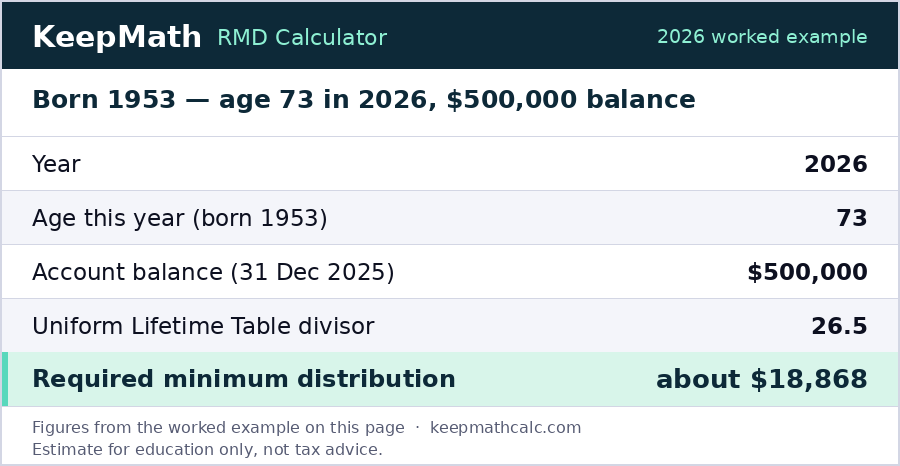
Take your account value from December 31 of last year and divide it by the IRS divisor that matches the age you reach this year. For 2026, that means your December 31, 2025 value and your age at the end of 2026.
What is the RMD age in 2026?
Age 73 applies to anyone born from 1951 through 1959, and age 75 applies to anyone born in 1960 or after. People born in 1953 reach 73 during 2026, so 2026 is when their first RMD applies.
Is the RMD age 72 or 73?
For most people it is now 73 or 75. Age 72 only matters for those born in 1950 or earlier, who are already taking withdrawals. Anyone born in 1951 or later begins at 73 or 75.
Which RMD table applies in 2026 and 2027?
The Uniform Lifetime Table, in use since 2022. If the IRS releases a revised table, this page will be refreshed. The calculator already offers a 2027 option.
Do Roth IRAs have required minimum distributions?
Not during your lifetime. Roth 401(k) and Roth 403(b) accounts also dropped lifetime RMDs beginning in 2024. Inherited Roth accounts are governed by separate rules.
What is the penalty for missing an RMD?
The IRS can charge 25% of whatever you failed to withdraw. That falls to 10% if you fix the shortfall within the correction window, generally two years. A waiver may be possible for a reasonable mistake.
Can I take my RMD in installments?
Yes. Monthly, quarterly or one lump payment all work, provided the full required amount has left the account by the deadline.
What if I have more than one IRA?
Work out the RMD for every traditional IRA, total them, and withdraw that sum from any one account or spread it across several. Each 401(k) or 403(b) has to be handled on its own.
Can I reinvest my RMD?
Not inside another retirement account, because an RMD is not eligible for rollover. You can move the cash into a regular taxable investment account or use it as spending money.
What balance do I use after a rollover or transfer?
Begin with the December 31 value your custodian reports. If funds moved between accounts near the end of the year, ask the custodian how to adjust the balance.
Can I download the RMD table as a PDF?
Yes. Open your browser's print dialog and choose Save as PDF, or use the print button in the calculator result.
How much do I have to withdraw from my IRA at age 73?
At 73 the divisor is 26.5, so you must withdraw about 3.8% of your December 31 balance. On $300,000 that comes to about $11,321.
How much would the RMD be on $500,000?
At age 73 it is about $18,868, at 75 about $20,325 and at 80 about $24,752. The amount rises with age because the divisor gets smaller.
What are the new RMD rules for 2026?
RMDs start at 73 if you were born from 1951 to 1959 and at 75 if you were born in 1960 or later. The penalty for missing one is 25% of the shortfall, or 10% if you fix it quickly. Roth 401(k) accounts have no lifetime RMDs from 2024, and the Uniform Lifetime Table has been in use since 2022.
What is the new RMD formula?
The formula itself has not changed: your December 31 balance from last year divided by the divisor for your age. What changed in recent years is the starting age and the updated life expectancy table.
Is there a free RMD calculator for 2026?
Yes. The calculator on this page is free, needs no sign-up and runs in your browser, so the numbers you enter are not sent anywhere.
Can I delay my first RMD to April 1?
Yes — once. You can take your first RMD any time in the year you turn 73 (born 1951–1959) or 75 (born 1960 or later), or push it to April 1 of the following year. But watch out: your second RMD is still due by December 31 of that same year. So delaying stacks two taxable RMDs onto one tax return — and that can push you into a higher bracket.
Can I give my RMD to charity (QCD)?
Yes. A qualified charitable distribution (QCD) sends money straight from your IRA to a charity — it never counts as taxable income, and it still counts toward your RMD for the year. For 2026, you can give up to $111,000 per person. You need to be 70½ or older, and the transfer has to be complete by December 31.
How this page was checked
The divisors were entered from the IRS Uniform Lifetime Table in Publication 590-B. The calculator results were then compared with separate hand calculations for several ages, balances and birth years, including a person who is too young for an RMD.
After your RMD number: what to do next
- Check your deadline first — December 31, or April 1 of the following year for your first RMD only, since delaying stacks two taxable RMDs onto one tax return — then run the calculator above with your birth year and your account balance from last December 31.
- Withdraw the full required amount by the deadline — total the RMDs for every traditional IRA, and handle each 401(k) or 403(b) on its own.
Sources and review
Last reviewed November 7, 2026. The divisors come from the IRS Uniform Lifetime Table in Publication 590-B and the starting ages from the SECURE 2.0 Act.
More calculators
- Lottery tax calculator to see what a lottery win leaves you after federal and state tax
- Bonus tax calculator to see what you keep from a bonus
- No tax on tips calculator if you earn tips
- No tax on overtime calculator if you are paid time-and-a-half
See what you keep after tax.
Try another calculator