Example numbers shown. Tap a box to type your own.
Full breakdown
| W-2 employee | 1099 at the same income | 1099 to match | |
|---|---|---|---|
| Yearly income | |||
| Social Security and Medicare | |||
| Federal income tax | |||
| Business costs | |||
| Take-home pay | |||
| Hourly rate |
Federal tax only. The last column takes home your W-2 pay plus the benefits value you entered.
Estimate for education only, not tax advice.
Key takeaways
- At the same income, a 1099 contractor keeps less than a W-2 employee, because the contractor pays both halves of Social Security and Medicare tax.
- For a single filer with no benefits and no business costs, a contractor needs about 7.5% more revenue just to match an employee's federal take-home pay.
- Once health insurance, a retirement match, unpaid time off and business costs are counted, the examples below call for 27% to 29% more.
- On $75,000, a single filer pays about $13,408 as an employee and about $17,101 as a contractor, using the standard deduction and no expenses.
What this W-2 vs 1099 calculator compares
You enter a W-2 salary, the yearly value of the benefits you would have to replace, your likely business costs as a contractor and your working hours. The calculator then answers two separate questions.
- Same income: if a contractor is paid exactly the same amount as the employee salary, how much less is left after federal tax?
- Break-even: how much would a contractor need to bill, per year and per hour, to take home as much as the employee does, plus the value of the benefits?
Only federal taxes are counted: Social Security, Medicare, self-employment tax and federal income tax with the 2026 standard deduction. State tax, credits, the qualified business income deduction and other deductions are left out, so treat the result as a comparison between the two options rather than a tax return.
How the W-2 side is calculated
An employee pays 6.2% Social Security tax on wages up to $184,500 and 1.45% Medicare tax on every dollar. The employer pays a matching amount on top, and that second half never reaches the employee's paycheck. Wages above $200,000 for single filers ($250,000 married filing jointly, $125,000 married filing separately) also face an extra 0.9% Medicare tax.
Federal income tax is then worked out on the salary after the standard deduction, using the 2026 brackets for your filing status. What remains after both taxes is the W-2 take-home pay used for the comparison.
How the 1099 side is calculated
A contractor starts with revenue and subtracts business expenses to reach net profit. Self-employment tax is charged on 92.35% of that profit: 12.4% for Social Security up to $184,500 and 2.9% for Medicare, with the same extra 0.9% above the Medicare thresholds. Half of the Social Security and Medicare portion is deductible when income tax is worked out.
Income tax then applies to profit minus that deductible half and the standard deduction. Whatever is left after expenses, self-employment tax and income tax is the contractor's take-home pay.
Where W-2 and 1099 tax treatment differs
| As an employee | As a contractor | |
|---|---|---|
| Social Security and Medicare | You pay 7.65% and your employer matches it | You cover both shares: 15.3% of 92.35% of profit |
| Tax withholding | Withheld in every pay period | Nothing is withheld, so installments are due quarterly |
| Work costs | Unreimbursed costs generally cannot be deducted | Subtracted from income on Schedule C |
| Benefits | Frequently supplied by your employer | Purchased by you |
| Tax form you receive | Form W-2 | Form 1099-NEC or 1099-K |
Converting a W-2 salary into a 1099 rate
- Start with take-home pay — what your salary leaves after federal tax.
- Add the benefits — the yearly value of health cover, retirement match and paid time off you would have to buy yourself.
- Add business expenses — software, equipment, insurance and accounting, since they come out before tax.
- Work backwards to the revenue — the billing that leaves that much after self-employment tax and income tax. The calculator does this step for you.
- Divide by billable hours — the hours you can really bill, which is fewer than 52 full weeks.
As a rule of thumb, a contractor needs about 7.5% more revenue to match the same salary before benefits and costs — for example, $161,289 of revenue, or $77.54 an hour, to match a $150,000 salary. With $10,000 of benefits, $3,000 of expenses and four unbilled weeks added, the same $150,000 salary takes $180,021, or $93.76 an hour. The full table and worked examples are in the W-2 vs 1099 guide.
Benefits and costs to price into a 1099 rate
- Health insurance: the part of the premium your employer pays today.
- Retirement match: employer contributions you would no longer receive.
- Paid time off: vacation, sick days and holidays you now get paid for. Enter them as unbilled weeks.
- Gaps between clients: time spent finding work, sending invoices and doing admin that nobody pays for.
- Business costs: software, equipment, insurance, accounting and professional fees.
- Quarterly tax planning: the money for estimated payments has to be kept aside from each invoice.
Worked examples
Every example is for 2026, uses the standard deduction and counts federal tax only.
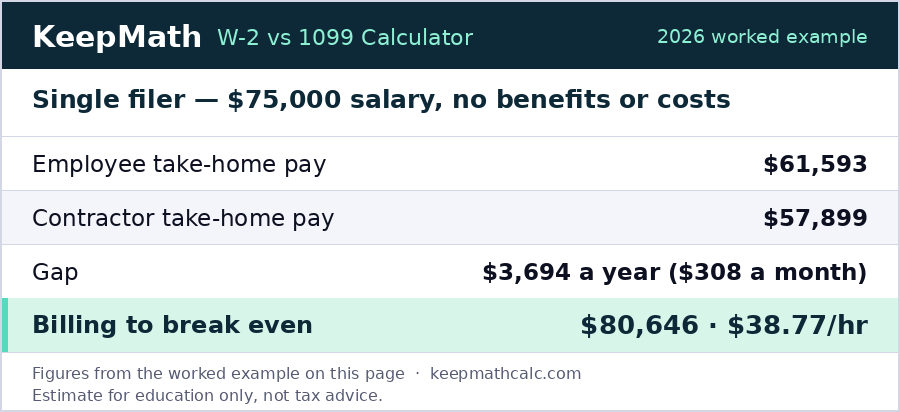
Single, $75,000 salary, no benefits or costs. As an employee the take-home pay is $61,593, after $5,738 of payroll tax and $7,670 of income tax. As a contractor paid the same $75,000 it is $57,899, after $10,597 of self-employment tax and $6,504 of income tax.
That is $3,694 less a year, or about $308 a month. To close the gap the contractor must bill $80,646, which is 7.5% more, or $38.77 an hour against $36.06 an hour for the employee.
Married filing jointly, $100,000 salary, $12,000 of benefits, $3,000 of costs, four unbilled weeks. The employee takes home $84,710. A contractor billing the same $100,000 keeps $76,837 after costs and tax.
To match the employee and replace the benefits, billing would need to reach $126,598, which is 26.6% higher. Over 1,920 billable hours that is $65.94 an hour, compared with $48.08 an hour on the salary.
Single, $150,000 salary, no benefits or costs. The employee keeps $113,791 and the contractor $106,615, a gap of $7,176.
Matching it takes $161,289 of revenue, or $77.54 an hour. The percentage gap is again 7.5%.
Single, $85,000 salary, $10,000 of benefits, $3,000 of costs, four unbilled weeks. The employee keeps $68,628. A contractor billing $85,000 keeps $62,478.
Matching the employee plus the benefits needs $109,684 of billing, 29.0% more than the salary, which works out to $57.13 an hour over 1,920 hours.
Contractor deductions this calculator leaves out
Contractors can sometimes reduce their income tax further through the self-employed health insurance deduction, contributions to a SEP IRA or solo 401(k), a home office and the qualified business income deduction. None of these are in the calculation, so the 1099 results here lean cautious. A tax professional can tell you which of them fit your situation.
Can you choose between W-2 and 1099?
Usually not. The IRS looks at the working relationship, not at what you or the company prefers. It weighs behavioral control (who directs how the work is done), financial control (who pays expenses and who can profit or lose) and the type of relationship, including contracts and benefits. Some states apply stricter tests.
If you are unsure, Form SS-8 lets you ask the IRS for a ruling on your worker status.
Quarterly payments and forms for contractors
Nobody withholds tax from 1099 income. If you expect to owe $1,000 or more for the year, the IRS generally expects installments on April 15, June 15, September 15 and January 15 of the following year, paid through Form 1040-ES. You report the income and costs on Schedule C and figure self-employment tax on Schedule SE.
Common mistakes in W-2 vs 1099 comparisons
- Comparing a salary with the same amount of contractor revenue and ignoring that the contractor pays both halves of payroll tax.
- Dividing a salary by 2,080 hours to get a rate. A contractor never bills every week of the year.
- Leaving out the cost of health insurance, retirement saving and time off.
- Forgetting self-employment tax when estimating quarterly payments.
- Treating the choice as optional when the work relationship decides the status.
Questions
Do you pay more taxes on 1099 or W-2?
On the same income, a 1099 contractor pays more federal tax, because self-employment tax covers both halves of Social Security and Medicare. On $75,000, a single filer pays about $13,408 as an employee and about $17,101 as a contractor, using the standard deduction and no expenses.
What percentage of tax do I pay on 1099 income?
Self-employment tax is 15.3% of 92.35% of your profit, about 14.1%. Income tax comes on top at your bracket rates. For a single filer with $75,000 of profit, the combined federal share is about 22.8%.
How do I convert my W-2 salary to a 1099 rate?
Work out your take-home pay, add the value of benefits you would replace and your business costs, and find the revenue that leaves that amount after self-employment tax and income tax. Divide it by the hours you can bill. The calculator above does these steps.
How do I calculate taxes from a W-2?
Add 7.65% payroll tax (6.2% Social Security up to $184,500 and 1.45% Medicare) to the federal income tax on your salary after the standard deduction. For a single filer on $75,000 that is about $5,738 plus $7,670.
Is $100,000 on a W-2 the same as $100,000 on a 1099?
No. A single filer with no expenses keeps about $79,180 as an employee and $74,255 as a contractor for federal tax purposes, a gap of $4,925 a year.
How much more should a contractor charge than an employee earns?
At least about 7.5% more, before benefits and costs, to cover the extra payroll tax. With benefits, costs and unpaid time off added, the examples on this page need 27% to 29% more.
Can I choose 1099 instead of W-2?
Not always. Worker status depends on the real working relationship, and the IRS and some states test it using specific factors. Form SS-8 asks the IRS for a determination.
Does this calculator include state tax?
No. It covers federal Social Security, Medicare, self-employment tax and federal income tax only.
Why does the calculator ask for hours and unbilled weeks?
They turn the revenue you need into an hourly rate. An employee is paid for holidays and sick days, but a contractor only earns during billable hours.
Is the W-2 vs 1099 calculator accurate?
It is a planning estimate based on 2026 federal figures and the standard deduction. It leaves out state tax, credits and extra deductions, so your own return can come out different.
What is an S-corp and when does it save tax?
Electing S-corp status — filed on Form 2553 — lets you pay yourself in two ways: a reasonable salary, taxed like any employee's wages, and the remaining profit as distributions. Distributions escape Social Security and Medicare tax entirely, which saves roughly 15.3% on that slice of profit. The trade-off is the salary itself: it must be a realistic market wage, or the IRS can treat distributions as wages. After payroll and filing costs, the election generally only pays once profit runs above roughly $60,000–$80,000 year after year.
Can my employer misclassify me as a 1099 contractor?
Yes — and it happens more often than people think. The IRS looks at three things: behavioral control (does the company tell you how to do the work?), financial control (do you set your own rates and use your own tools?) and the type of relationship (benefits, how permanent the arrangement is). If you're really an employee, you can ask the IRS to rule on it with Form SS-8 — but be ready to wait; it takes 6 months or more.
After the comparison: what to do next
- List the benefits you would have to replace first — health cover, retirement match, paid time off — then run the calculator with your W-2 salary, those benefits, your business costs and your working hours.
- Compare the take-home pay on both sides, then look at the 1099 revenue and hourly rate you would need to match your salary.
- If you are unsure about your worker status, Form SS-8 lets you ask the IRS for a ruling — and if you switch to contracting, keep money aside from each invoice for the quarterly estimated payments.
Sources and review
Last reviewed November 7, 2026. Brackets and standard deductions come from IRS Revenue Procedure 2025-32. The $184,500 Social Security limit is the Social Security Administration figure for 2026. Check IRS.gov for the latest before you file.
More calculators
- 1099 tax calculator with deductions to see your full self-employment and income tax bill
- Bonus tax calculator to see what you keep from a bonus
- No tax on overtime calculator if you work overtime as an employee
- No tax on tips calculator if you earn tips
- All calculators
See what you keep after tax.
Try another calculator