Example numbers shown. Tap a box to type your own.
Full breakdown
| Vest value (shares × price) | |
| Federal income tax withheld | |
| Social Security tax (6.2%) | |
| Medicare tax (1.45%) | |
| Additional Medicare tax withheld (0.9%) | |
| State tax | |
| Total withheld at vest | |
| Federal income tax the vest really adds | |
| Additional Medicare tax you really owe | |
| Federal bracket on the top dollars | |
| Shares sold to cover (estimate) | |
| Cash left after full tax |
Federal estimate uses the 2026 standard deduction and bracket amounts. State tax is treated as withheld at the rate you enter, so it adds nothing to the gap.
Estimate for education only, not tax advice.
Key takeaways
- The full market value of the shares on vest day is added to your wages. Vest day creates ordinary income equal to shares times price.
- Your employer usually withholds 22% federal tax on it, plus Social Security and Medicare, plus state tax where it applies.
- What you actually owe depends on the tax bracket the vest pushes you into, so the final federal bill can be higher or lower than the 22% that was withheld.
- The vest-day price is your cost basis. A later sale is taxed only on how far the price has moved since then.
- Supplemental pay above $1 million in a calendar year must be withheld at 37%.
In one line
Your gap is the federal tax the vest really adds minus the 22% your employer already took
What happens, from vest day to sale
- VestOn the vest date the shares move into your brokerage account, and their market price that day is booked as extra pay on your W-2.
- PayrollPayroll takes tax out of that extra pay straight away, usually by selling part of the shares, and sends it to the IRS and your state.
- ReturnWhen you file, a full year of income is taxed together and the tax already paid is subtracted. What is left over is your gap.
- SaleSelling later creates a gain or loss measured from the vest-day price, which serves as your starting cost basis.
Why 22% is only a down payment
The flat supplemental rate is a payroll convenience. It does not know your salary, your spouse or your deductions. The table shows what that means for a $20,000 vest if the whole vest were taxed at one bracket. Real vests often straddle two brackets, which the calculator handles, so treat this as the pattern rather than the answer.
| Your bracket | Withheld (22%) | Federal tax owed | At tax time |
|---|---|---|---|
| 10% | $4,400 | $2,000 | Refund $2,400 |
| 12% | $4,400 | $2,400 | Refund $2,000 |
| 22% | $4,400 | $4,400 | Even |
| 24% | $4,400 | $4,800 | Owe $400 |
| 32% | $4,400 | $6,400 | Owe $2,000 |
| 35% | $4,400 | $7,000 | Owe $2,600 |
| 37% | $4,400 | $7,400 | Owe $3,000 |
Federal income tax only. Social Security and Medicare are withheld at their real rates, so they do not create a gap.
Warning: The tax is fixed by the vest-day value
If the stock price falls after the vest, the shares are worth less but the tax bill stays the same. If you sell below your basis, the capital loss can offset other gains and up to $3,000 of ordinary income per year, with any excess carried forward.
The 2026 figures behind the math
The $1 million limit counts all of your supplemental wages in the calendar year, including bonuses, so an early-year vest can use up part of it.
The Social Security wage base is a limit on total wages, which is why a salary near or above $184,500 leaves little or no Social Security tax on the vest.
Medicare has no limit, and the extra 0.9% begins when wages pass $200,000, even though your own threshold may be $250,000 if you are married filing jointly.
Income tax is worked out with the 2026 brackets and standard deduction for your filing status, with and without the vest, and the difference is the federal tax the vest adds.
Four vests, worked through
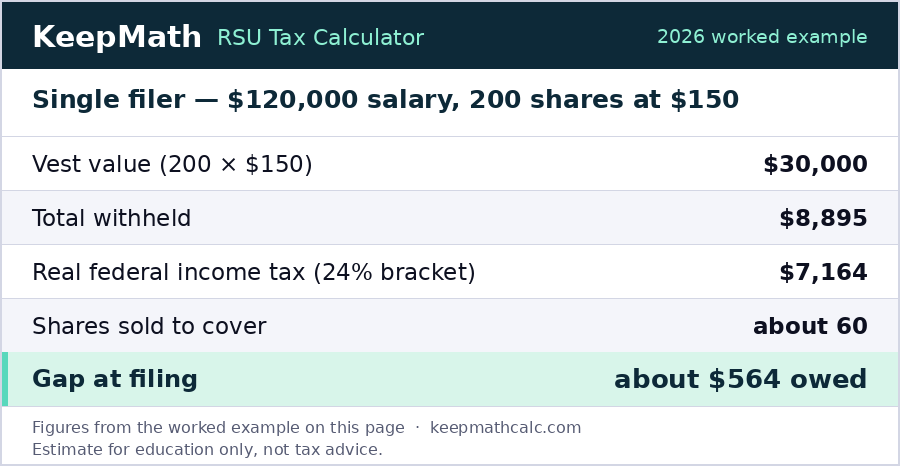
A mid-career engineer
Single, $120,000 salary, 200 shares at $150 ($30,000 vest)
- Withheld: $6,600 federal, $1,860 Social Security, $435 Medicare, $8,895 in all
- Shares sold to cover: about 60
- Real federal income tax on the vest: $7,164 at the 24% bracket
Gap: about $564 owed
A married couple in California
Married filing jointly, $250,000 income, 500 shares at $120 ($60,000 vest), California at 10.23%
- Withheld: $13,200 federal, $540 Additional Medicare, $870 Medicare, $6,138 state, $20,748 in all
- Shares sold to cover: about 173
- Real federal income tax: $14,400 at the 24% bracket, plus $540 Additional Medicare
Gap: about $1,200 owed
A large vest on a high salary
Single, $180,000 salary, 1,000 shares at $220 ($220,000 vest)
- Withheld: $48,400 federal, $1,800 Additional Medicare, $279 Social Security, $3,190 Medicare
- Shares sold to cover: about 244
- Real federal income tax: $71,200, because the vest runs through the 24%, 32% and 35% brackets
Gap: about $22,800 owed
An early-career vest
Single, $60,000 salary, 100 shares at $50 ($5,000 vest)
- Withheld: $1,100 federal, $310 Social Security, $73 Medicare, about $1,483 in all
- Shares sold to cover: about 30
- Real federal income tax: $600, since the vest sits mostly in the 12% bracket
Gap: about $500 refund
These examples come straight from the calculator above with no state tax unless stated. Change one input at a time to see which one moves the gap most. It is nearly always salary.
Sell-to-cover, net settlement or paying cash
How the tax gets paid does not change what you owe, but it changes what you hold afterwards. Your plan decides which methods exist, and some let you pick.
Sell to cover
The broker sells just enough of the vesting shares to pay the withholding, and you keep the rest. It is the most common default. Because the sale happens at the vest price, there is little or no gain to report on those shares.
Net settlement
The company keeps back shares itself and pays the tax from them, so you simply receive fewer shares. The tax is the same. Nothing is sold in your account, which can mean fewer lines to deal with on Form 1099-B.
Pay with cash
Where it is offered, the tax comes out of your paycheck or a payment you make, and you keep every share. You also keep all the price risk on a larger position, and the tax is due whether the stock rises or falls.
Closing the gap before April
- Run the calculator with your real vest value and salary, and note the gap and the federal bracket it shows.
- If you owe, you can raise withholding on your paycheck with Step 4(c) of Form W-4. The IRS treats withholding as paid evenly through the year, even if you add it late.
- Or send estimated tax with Form 1040-ES or IRS Direct Pay. The fourth payment for 2026 is due January 15, 2027.
- Check the safe harbor: pay at least 90% of this year's tax or 100% of last year's. The second figure becomes 110% if your adjusted gross income last year was over $150,000. Meeting it avoids an underpayment penalty even if you still owe a balance.
- Keep the cash. If your shares are not sold at vest, set aside part of the gap in cash rather than counting on the future price.
State tax on RSUs
Alaska, Florida, Nevada, South Dakota, Tennessee, Texas, Washington and Wyoming do not tax wages, so a vest there carries no state income tax.
California is a common case: the state's payroll rules call for a flat 10.23% withholding on stock options and bonuses, which many employers apply to RSUs. Your real California rate can be lower or higher, up to 13.3% at the top, and California also charges payroll disability insurance on wages.
The calculator treats state tax as withheld at the rate you type, so it shows up in your total but not in the gap. That keeps the headline number focused on federal tax, which is where the large surprises come from. If you work in more than one state during the vesting period, the income can be split between them. A tax professional is worth the fee in that case.
Cost basis: how to avoid paying twice
An RSU is taxed at two separate moments, but never twice on the same dollars. The first is the vest, when the shares count as wages. The second is the sale, when only the price movement matters.
Whatever the shares were worth at vesting is treated as what you paid for them, so that figure is the starting point for any later profit or loss. The short-term or long-term clock starts then too: hold for more than a year and the profit gets the lower long-term rates, otherwise it is taxed like ordinary income.
The danger sits in the paperwork. Form 1099-B from a broker sometimes reports a basis of zero, or none at all, for RSU shares. File with that figure and the entire sale proceeds look like profit, so you would be paying tax again on money already taxed as wages. Compare each sale with your vest confirmations and correct the basis on Form 8949 whenever it is off.
What this calculator leaves out
- ISOs, NSOs and ESPP, which follow different rules.
- Capital gains from selling the shares later, including the 3.8% net investment income tax that can apply to them.
- Credits, itemized deductions and the pre-tax deductions that lower your wages.
- City taxes, state disability or family leave payroll taxes, and differences between a state's withholding and its final tax.
- Employer-specific withholding choices beyond the single rate you can enter above.
- Vests for people who are not US taxpayers.
It is a planning estimate. Your W-2 and a tax professional have the final say.
Questions
How much tax will I owe when my RSUs vest?
The full market value of the shares on vest day is added to your wages. Your employer usually withholds 22% federal tax on it, plus Social Security and Medicare, plus state tax where it applies. What you actually owe depends on the tax bracket the vest pushes you into, so the final federal bill can be higher or lower than the 22% that was withheld.
Why is the tax taken from my RSUs lower than what I end up owing?
Payroll uses a flat supplemental rate of 22% and does not look at your bracket. If the vest lands in your 24%, 32%, 35% or 37% bracket, the difference becomes a balance due when you file. If your top bracket is 12% or 10%, the opposite happens and you get a refund.
Will I be taxed again when I sell the shares?
Not on the same dollars. Income tax was due on the vest-day value, so a later sale is taxed only on how far the price has moved since then. Sell at that price and no gain is owed, sell above it and the difference is a capital gain, and sell below it and you book a loss.
What happens to my RSU tax if the stock price falls after the vest?
The tax is fixed by the vest-day value, so a later drop makes the shares worth less but leaves the tax bill alone. If you sell below your basis, the capital loss can offset other gains and up to $3,000 of ordinary income per year, with any excess carried forward.
How many shares will my company sell to cover taxes?
Roughly the total amount withheld divided by the share price, rounded up to a whole share. The calculator shows that estimate. Your plan's exact withholding rates, state tax and rounding rules decide the real number.
Does the $1 million supplemental wage rule affect RSUs?
Yes. Supplemental pay above $1 million in a calendar year must be withheld at 37%. Most employees never reach it. If you vested earlier in the year, enter that amount in the calculator so the 22% and 37% split is applied correctly.
Do RSUs count toward the Social Security wage base?
They do, because the vest is wages. Social Security tax of 6.2% stops once your wages for the year reach $184,500 in 2026. If your salary already exceeds that, the vest adds only Medicare tax. Medicare has no cap.
Is the 0.9% Additional Medicare Tax withheld on RSUs?
Employers must withhold it on wages above $200,000 in a calendar year, whatever your filing status. Your real threshold is $200,000 if single or head of household, $250,000 if married filing jointly and $125,000 if married filing separately, so married couples can be over- or under-withheld.
Do I owe tax when RSUs are granted?
Normally no. A standard RSU grant is a promise of shares, and tax applies when the shares vest and the restrictions lapse. The grant date matters for your vesting schedule, not for your tax bill.
Can I make an 83(b) election for RSUs?
No. An 83(b) election only works for restricted stock, where property changes hands at grant. An RSU is a promise of shares, not property, so there is nothing to elect on — the tax always falls at vest, on the vest-day value.
Should I make estimated tax payments after a big RSU vest?
Consider it if the gap is large and your other withholding will not cover the safe harbor, which is 90% of this year's tax or 100% of last year's, rising to 110% if last year's adjusted gross income was over $150,000. Extra W-4 withholding is an alternative that the IRS treats as paid evenly through the year.
Do I report RSU income on my return separately?
Normally you do not add it again. The vest value is already included in Box 1 of your W-2. What you do watch is Form 1099-B: if the broker reports a zero or missing cost basis for shares you sold, correct it with the vest-day value so the same income is not taxed twice.
Does this calculator work for ISOs, NSOs or an ESPP?
No. Those follow different rules, including the alternative minimum tax for ISOs and holding-period tests for ESPP shares. This page is built for standard RSUs that are taxed as wages on vest day.
What is the California RSU tax rate?
California payroll rules call for a flat 10.23% withholding on stock options and bonuses, which many employers apply to RSUs. Your real California rate can be lower or higher, up to 13.3% at the top, and California also charges payroll disability insurance on wages.
Sources and review
Last reviewed November 7, 2026. Brackets and standard deductions come from IRS Revenue Procedure 2025-32. The $184,500 Social Security limit is the Social Security Administration figure for 2026, and the withholding rules follow IRS Publication 15 and Topic 751. California's 10.23% flat rate is from the Employment Development Department. Check IRS.gov for the latest before you file.
More calculators
- Bonus tax calculator to see what you keep from a bonus
- W-2 vs 1099 tax calculator to compare a salary with contractor pay
- lottery tax calculator for another large lump sum
- No tax on overtime calculator if you also work overtime
- No tax on tips calculator if you also earn tips
See what you keep after tax.
Try another calculator