Example numbers shown. Tap a box to type your own.
Full breakdown
| Regular gross pay per check | |
| Bonus in this check | |
| Combined gross | |
| Federal withholding (flat method) | |
| Federal withholding (aggregate method) | |
| Social Security (6.2%) | |
| Medicare (1.45% + 0.9% over $200,000) | |
| State tax estimate | |
| Take-home, flat method | |
| Take-home, aggregate method | |
| Normal check take-home (no bonus) | |
| True federal tax on the bonus (at filing) |
Estimated with the 2026 federal brackets and standard deduction. The flat method withholds 22% on the bonus portion (37% over $1 million of supplemental wages). The aggregate method annualizes the whole check. Your payroll system may differ by a small amount.
Estimate for education only, not tax advice.
Key takeaways
- A bonus faces no special higher rate — it is ordinary income, and 22% is only the withholding.
- Two withholding methods exist: flat 22% on the bonus, or the aggregate method that annualizes the whole check.
- The aggregate method usually withholds more on a big check, because it pretends you earn that much every period.
- Social Security tax (6.2%) still applies to the bonus until your wages reach $184,500 for 2026.
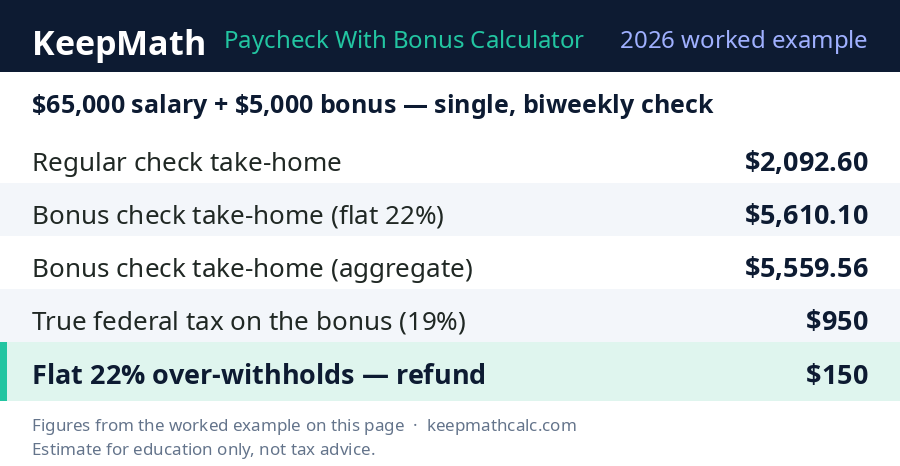
- Whatever is over-withheld comes back as a refund. In the worked example, $150 of the $1,100 withheld on the bonus returns.
How a bonus in your paycheck is taxed
Start with the part that calms most people down: there is no bonus tax. The IRS taxes a bonus exactly like salary — it is added to your wages for the year and run through the same 2026 brackets, 10% up to 37%. What makes a bonus check look heavily taxed is withholding, the amount your employer sends to the IRS in advance. Withholding is an estimate, and on bonuses the estimate is deliberately rough.
The IRS calls bonuses "supplemental wages" — pay that is not part of your regular salary. IRS Publication 15 gives employers two ways to withhold federal tax on them. The first is the flat method: hold back 22% of the bonus, full stop (37% on any part that takes your supplemental wages past $1 million for the year). The second is the aggregate method: add the bonus to your regular pay for the period, work out withholding on the combined amount as if it were normal pay, and take that from the check. Your employer picks one method; you do not get a say, which is why two coworkers with the same bonus can see different take-home amounts.
On top of federal withholding, the bonus is still wages for payroll tax. Social Security takes 6.2% until your year-to-date wages reach the 2026 wage base of $184,500, Medicare takes 1.45% on every dollar, and an extra 0.9% Medicare tax is withheld on wages over $200,000 paid by the same employer. State tax depends on where you live — enter your rate in the calculator to include it.
Flat 22% vs the aggregate method
The flat method is simple and predictable: whatever the bonus, 22 cents of each dollar is held back for federal tax. If your real marginal rate is 12%, that over-withholds by 10 cents on the dollar; if your real rate is 24% or 32%, it under-withholds and you settle up in April. The aggregate method is more complicated. Payroll pretends the combined check — salary plus bonus — is what you earn every pay period, annualizes it, applies the brackets and standard deduction, then divides back down. A one-off bonus makes that annual figure look far bigger than your real salary, so the withholding rate on that check jumps.
| Flat method | Aggregate method | |
|---|---|---|
| Federal withholding on the bonus | 22% flat (37% over $1M of supplemental wages) | Whatever the annualized brackets produce |
| Best for | Predictable checks; bonuses paid separately | Bonuses folded into a regular check |
| Typical surprise | Over-withholds if your bracket is 10% or 12% | Withholds a lot on one big check, then settles later |
| Your actual tax | Identical either way — the bonus is taxed once, at your real rates, when you file | |
The calculator above runs both methods on the same check so you can see which one your pay stub used. If the federal line on your stub is close to 22% of the bonus plus your normal withholding, your employer used the flat method. If it is noticeably higher, it was probably the aggregate method.
Worked example: $65,000 salary plus a $5,000 bonus
Take a single filer on a $65,000 salary, paid every two weeks — $2,500 a check — who gets a $5,000 bonus in one of those checks. No 401(k), no pre-tax health premiums, no state tax, to keep the moving parts visible.
| Line | Normal check | Bonus check (flat) | Bonus check (aggregate) |
|---|---|---|---|
| Gross pay | $2,500.00 | $7,500.00 | $7,500.00 |
| Federal withholding | $216.15 | $1,316.15 | $1,366.69 |
| Social Security (6.2%) | $155.00 | $465.00 | $465.00 |
| Medicare (1.45%) | $36.25 | $108.75 | $108.75 |
| Take-home | $2,092.60 | $5,610.10 | $5,559.56 |
Now the part that matters: what is the bonus really taxed at? On $65,000 alone, the 2026 federal tax is $5,620. On $70,000 (salary plus bonus) it is $6,570. The bonus therefore adds $950 of real tax — a 19% blended rate, because part of it fills the 12% bracket and the rest spills into the 22% bracket. The flat method withheld $1,100 on the bonus, so $150 of that comes back as a refund. The aggregate method withheld even more on the check — $1,366.69 of federal tax in total — because it annualized the $7,500 check to a $195,000 salary that this person does not earn.
Notice the take-home jump: the bonus check nets $5,610.10 against a normal $2,092.60, so the $5,000 bonus put $3,517.50 of extra cash in hand on the day. After the $150 refund at filing time, the bonus is worth $3,667.50 in total. The calculator shows both the check-day figure and the true tax so you can plan around either.
Why the aggregate method spikes
Payroll software does not know your bonus is a one-off. Under the aggregate method it takes the combined check, multiplies it by the number of pay periods in a year, subtracts the standard deduction, and runs the result through the brackets. A $7,500 biweekly check becomes a $195,000 "salary" in that math, and income at that level is taxed at 24% and 32% on the margin — rates this employee never actually reaches. The withholding is then divided back to a per-check figure, but the damage is done: the rate applied to the bonus portion is far above the person's real rate.
This is also why the aggregate method hurts most on large, infrequent bonuses and barely matters on small ones. A $500 bonus barely moves the annualized figure; a $20,000 bonus can push the pretend salary into the 35% bracket. None of it changes the final bill — over-withholding is refunded — but it does change your cash flow for months, which is the real cost. If your employer uses the aggregate method and a big bonus is coming, it is worth knowing the refund is locked up until you file.
Does your 401(k) come out of the bonus?
Often, yes — and it surprises people. Many 401(k) plans apply your normal deferral percentage to every paycheck, bonus checks included. If you defer 10% of pay and a $5,000 bonus lands in the check, an extra $500 goes into the 401(k) before you see it. That is not a loss: the money is still yours, it just arrives at retirement instead of now, and it lowers the taxable part of the bonus today. The calculator's 401(k) box spreads your annual contributions evenly across checks, which approximates how most plans behave.
If you would rather have the full bonus in cash — for a house deposit, say — check whether your plan lets you set a separate election for bonus pay, or temporarily change your deferral rate before the bonus check and change it back after. Some plans also have a separate "bonus deferral" election. Ask HR before the pay date; after the check runs, the deferral cannot be undone.
When the flat 22% is not enough
The flat rate cuts the other way for high earners. If your salary already puts you in the 24%, 32% or 35% bracket, a bonus withheld at 22% is under-withheld by 2 to 13 cents on the dollar, and the shortfall shows up as a balance due in April — possibly with an underpayment penalty if it is large. A $50,000 bonus in the 32% bracket is under-withheld by about $5,000. The fix is to add extra withholding on Form W-4 for the rest of the year, or make a quarterly estimated payment; the quarterly estimated tax calculator works out the safe amount.
The same logic applies at the top end of the payroll taxes. Once your wages pass $184,500, Social Security tax stops for the year, so a late-year bonus keeps an extra 6.2%. The calculator's "wages already paid" box handles that: enter your year-to-date wages and the Social Security line shrinks or disappears once the cap is crossed.
Paycheck with bonus questions
Is a bonus taxed at a higher rate than salary?
No. A bonus is ordinary income, taxed at the same 2026 rates as your salary. The 22% you see on the pay stub is withholding — a prepayment — not a special bonus tax rate. Your real rate on the bonus is whatever bracket it lands in, which is often 12% or 22% for middle earners.
Why did so much tax come out of my bonus check?
Two usual reasons. With the flat method, 22% is withheld even if your real rate is 12%. With the aggregate method, payroll annualizes the whole check as if you earned that much every period, which pushes the math into higher brackets for that one check. Either way, the over-withholding comes back when you file.
Will I get the extra withholding back?
Yes, if more was withheld than you actually owe. The bonus is added to your wages on your W-2 and taxed once, at your real rates. Any excess withholding is refunded with your return — the calculator shows the gap for the example numbers.
What happens if my bonus is over $1 million?
Federal withholding on supplemental pay past $1 million within a calendar year is a mandatory 37% on the excess — your employer has no choice. Under $1 million, the flat rate is 22%.
Does Social Security tax apply to a bonus?
Yes. Bonuses are wages for Social Security and Medicare. The 6.2% Social Security tax applies until your year-to-date wages reach the 2026 wage base of $184,500, and the 1.45% Medicare tax applies to every dollar, plus 0.9% on wages over $200,000 paid by one employer.
Can I lower the withholding on a bonus check?
You cannot change the 22% flat rate itself, but you can adjust your Form W-4 for the rest of the year to withhold less from regular checks, or ask whether your 401(k) plan lets you defer part of the bonus. Deferring lowers the taxable bonus now and the tax is paid when you withdraw in retirement.
Is a bonus taxed differently if it is paid on a separate check?
The tax is identical — it is all wages. What can differ is the withholding method: a separate check is usually withheld at the flat 22%, while a bonus inside your regular check may be aggregated with your salary. The calculator compares both.
How this page was checked
The regular-check math follows the same annual method as the state paycheck calculators on this site: 2026 brackets and standard deduction from IRS Revenue Procedure 2025-32, Social Security wage base $184,500 from the SSA, and the 22% / 37% supplemental rates and aggregate method from IRS Publication 15. The worked example was recomputed by hand: $5,620 of tax on $65,000, $6,570 on $70,000, a $950 true tax on the bonus.
Sources and review
Reviewed November 2026. Withholding methods follow the supplemental-wages section of IRS Publication 15; the 2026 brackets and standard deduction are from Revenue Procedure 2025-32.
Other calculators to try
- Bonus tax calculator for a bonus paid on its own check
- Commission tax calculator if your extra pay is commission
- Texas paycheck calculator for a regular paycheck with no state tax
- Quarterly estimated tax calculator if a big bonus leaves you under-withheld
See what you keep after tax.
Try another calculator