Example numbers shown. Tap a box to type your own.
Full breakdown
| Self-employment tax (15.3% on 92.35%) | |
| Federal income tax | |
| Total 2026 tax | |
| Test 1: 90% of 2026 tax | |
| Test 2: last year's tax (100% / 110%) | |
| Required annual payment (smaller test) | |
| Per installment (4 payments) | |
| Balance due April 2027 | |
| Penalty if you pay nothing (est.) |
Due dates: Apr 15, Jun 15, Sep 15, 2026 and Jan 15, 2027. SE tax uses the $184,500 wage base; half of it is deducted from income. This estimate excludes the 20% qualified business income deduction, so it errs on the safe (higher) side. Penalty estimate uses 7% simple interest to April 15, 2027.
Estimate for education only, not tax advice.
Key takeaways
- 2026 due dates: April 15, June 15, September 15, 2026 and January 15, 2027 — the "quarters" are not equal months.
- Safe harbor: pay whichever is lower — 90% of this year's tax, or 100% of last year's (110% when last year's AGI topped $150,000).
- 1099 profit owes self-employment tax first: 15.3% on 92.35% of net earnings, before income tax.
- The penalty is interest-based (7% for late 2026), charged per installment from its due date — not a flat fine.
- File and pay in full by February 1, 2027 and the January 15 payment is not required.
Who has to pay estimated tax?
Employees never think about this because their employer withholds tax from every paycheck and sends it to the IRS all year. If you earn 1099 income — freelance, contract, gig, or your own business — nobody withholds anything, so the IRS requires you to prepay your tax in four installments instead. The general trigger: you expect to owe at least $1,000 in tax after subtracting withholding and refundable credits. Below that, no estimates are needed.
Two groups get caught out. The first is new freelancers who assume the bill arrives next April; it does, but with an underpayment penalty attached for the quarters that were skipped. The second is people with both a W-2 job and side income: their withholding may cover the job but not the side income, especially the self-employment tax on it. The calculator handles both — enter W-2 wages and expected withholding alongside the 1099 profit, and it works out whether estimates are still required. If you are comparing the two worlds entirely, the W-2 vs 1099 calculator shows the full-year difference.
2026 due dates
The four installments are not calendar quarters. The second period is only two months and the fourth is four, which matters if your income is seasonal. None of the 2026 dates falls on a weekend or federal holiday, so no date shifts this year.
| Installment | Income period | Due date |
|---|---|---|
| 1st | January 1 – March 31, 2026 | Wednesday, April 15, 2026 |
| 2nd | April 1 – May 31, 2026 | Monday, June 15, 2026 |
| 3rd | June 1 – August 31, 2026 | Tuesday, September 15, 2026 |
| 4th | September 1 – December 31, 2026 | Friday, January 15, 2027 |
Pay through IRS Direct Pay or EFTPS and select the 2026 tax year and Form 1040-ES. Keep the confirmation numbers — if a payment is ever misapplied, they are your proof. States run their own estimated tax systems with their own dates; this page covers federal only.
The safe harbor: two tests, pay the smaller
You do not have to guess your final tax bill perfectly. The IRS gives you two targets, and reaching either one — in four on-time installments — guarantees the penalty stays at zero, even when April brings a large balance:
- 90% of this year's tax. Best when this year's income drops or you can estimate it well.
- 100% of last year's tax — from a return that covered 12 months. If last year's AGI was over $150,000 ($75,000 if married filing separately), the target is 110% of last year's tax instead.
Whichever target is smaller is your "required annual payment." Subtract any withholding you expect (from a W-2 job, for instance), divide by four, and that is the installment. The prior-year test is the freelancer's friend: after a low-income year, this year's payments stay low even if business booms — the extra tax is simply due next April, penalty-free. The reverse also holds: after a big year, the prior-year test can demand more than you will actually owe, and the 90% test (or the annualized method below) is the better route.
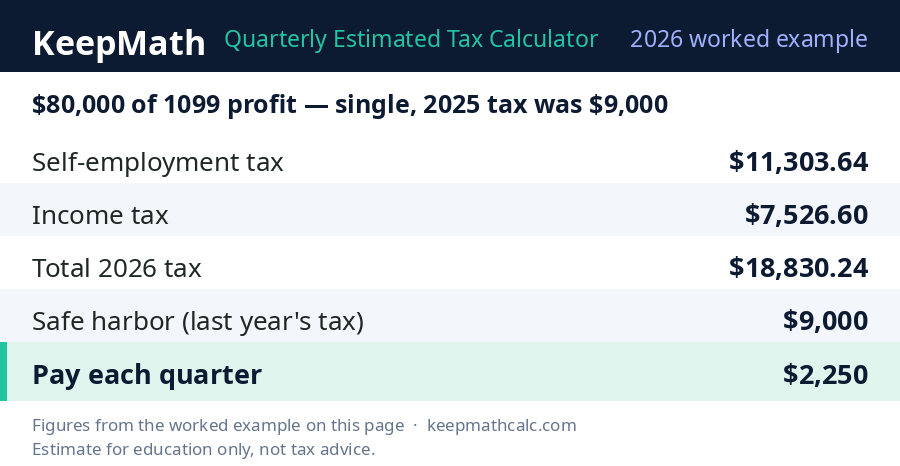
Worked example: $80,000 of 1099 profit
Take a single freelancer expecting $80,000 of net profit in 2026, with no W-2 job. Last year (2025) their total tax was $9,000 on an AGI of $70,000. First, the full 2026 tax:
| Line | Amount |
|---|---|
| Net profit | $80,000.00 |
| SE tax base (× 92.35%) | $73,880.00 |
| Social Security part (12.4%) | $9,161.12 |
| Medicare part (2.9%) | $2,142.52 |
| Self-employment tax | $11,303.64 |
| Less half of SE tax (deductible) | −$5,651.82 |
| Adjusted gross income | $74,348.18 |
| Less standard deduction | −$16,100.00 |
| Income tax | $7,526.60 |
| Total 2026 tax | $18,830.24 |
Now the safe harbor. Test 1 is 90% of $18,830.24 = $16,947.22. Test 2 is 100% of last year's $9,000 (AGI was under $150,000, so no 110%). The smaller target wins: required annual payment $9,000, or $2,250 per installment. Pay those four on time and there is no penalty — the remaining $9,830.24 is due with the return in April 2027. Skip the payments entirely and the penalty, at 7% interest, works out to roughly $419 (the April installment alone accrues for a full year). One conservative note: this estimate leaves out the 20% qualified business income deduction, which would cut the income tax to about $4,957 and the total to about $16,261. The safe-harbor payment is unaffected here because the prior-year test is smaller either way — but if the 90% test is your binding one, the QBI deduction lowers your installments. The 1099 tax calculator shows the QBI effect on the full-year bill.
How self-employment tax fits in
Estimated payments must cover two taxes, not one. Income tax is the familiar one. Self-employment tax is the payroll tax employees split with their employer — as your own employer, you pay both halves: 12.4% for Social Security plus 2.9% for Medicare, totaling 15.3%, applied to 92.35% of net earnings (the 7.65% reduction mirrors the employer share employees never see). The 12.4% Social Security portion ends once earnings reach the $184,500 ceiling for 2026, and any W-2 wages you have consume that base first — a $150,000 salary leaves only $34,500 of room for the 12.4% on side income. Medicare has no cap, and an extra 0.9% applies over $200,000 (single) or $250,000 (joint) of combined wages and SE income.
Half of the SE tax is deductible from income — an adjustment that lowers your income tax but not the SE tax itself. In the worked example, SE tax is the bigger of the two bills ($11,304 of the $18,830), which is typical at moderate profit levels and the reason 1099 workers are shocked by their first tax bill: roughly 24 cents of every profit dollar goes to tax before state tax even enters the picture.
Uneven income: annualized installments
The four equal installments assume income arrives evenly. If most of your money lands in December — a year-end contract, holiday-season sales — equal installments force you to prepay tax on income you have not earned yet. The annualized income installment method fixes this: you compute each installment from the income actually earned in that period, annualized, using Schedule AI of Form 2210. Early payments shrink; the January payment grows to catch up.
The trade-off is paperwork. You must file Form 2210 with Schedule AI to claim the method, and you need decent period-by-period records. It is worth it when income is heavily back-loaded, and pointless when it is steady. A simpler cousin of the same idea: if you also have a W-2 job, increase your W-4 withholding late in the year instead. Withholding is treated as paid evenly across all four periods regardless of when it was actually withheld, so a December withholding bump can retroactively cover a missed April installment — something an estimated payment cannot do.
The underpayment penalty
Despite the name, it behaves like interest, not a fine. The rate is the federal short-term rate plus 3 percentage points, reset each quarter — 7% for the quarter beginning October 1, 2026. It is charged separately on each installment: from that installment's due date until April 15 of the following year, or until you pay, whichever is earlier. That is why the April installment is the expensive one to miss (365 days of interest) and the January one the cheapest (90 days).
The IRS computes it on Form 2210 and bills you after filing; you can also let the IRS figure it and simply pay the notice. There are narrow waivers — casualty, disaster, or unusual circumstances, and for people who retired or became disabled after age 62 with a reasonable cause — but "I forgot" is not one of them. The reliable protection is the safe harbor: hit the required annual payment on time and the penalty is zero no matter how large the April balance turns out to be.
The January 15 → February 1 option
The fourth installment has an escape hatch the others do not. If you file your 2026 return and pay the entire balance by Monday, February 1, 2027, the January 15 payment is not required at all — the early filing replaces it. This suits people whose records are ready in January and who would rather settle once than pay an estimate and then true it up weeks later.
It is a narrow window, though: the return must be complete, not just started, and the full balance must be paid with it. If a stray 1099 form arrives late and forces an amendment, the January installment was still skipped legitimately — but an amended return showing more tax can revive penalty calculations on the earlier quarters. When in doubt, making the January payment and filing at leisure is the calmer path.
Estimated tax questions
How much should I pay in estimated taxes?
Enough to reach the safe harbor: whichever is lower: 90% of this year's total tax, or 100% of last year's total tax (110% when last year's AGI was over $150,000, or $75,000 filing separately), paid in four timely installments after subtracting any withholding. Hit that number and there is no underpayment penalty, even if you owe more in April.
When are 2026 estimated taxes due?
Wednesday April 15, Monday June 15 and Tuesday September 15, 2026, and Friday January 15, 2027. The periods are uneven: January 1–March 31, April 1–May 31, June 1–August 31 and September 1–December 31.
Do I have to pay estimated taxes on 1099 income?
Generally yes, if you expect to owe at least $1,000 after withholding and credits. Nothing is withheld from 1099 payments, so the IRS expects you to prepay through quarterly estimates — including self-employment tax, which employees never see as a separate bill.
What is the safe harbor rule?
A pair of tests that guarantee no underpayment penalty: pay 90% of the current year's tax, or 100% of last year's tax (110% above $150,000 of AGI), in four on-time installments. You only need the smaller of the two, which is why a low prior-year tax bill makes this year's payments cheap.
How is self-employment tax calculated?
15.3% on 92.35% of net self-employment earnings: 12.4% for Social Security on earnings up to the $184,500 limit (reduced by any W-2 wages) plus 2.9% for Medicare, with an extra 0.9% over $200,000 single / $250,000 joint. Half of the SE tax is deducted from income.
What is the penalty for not paying estimated taxes?
It is interest-based: the federal short-term rate plus 3 points, reset every quarter — 7% for the quarter starting October 1, 2026. It runs on each underpaid installment from its due date to April 15 of the next year, so missing the April payment costs the most.
Can I skip the January 15 payment?
Yes. If you file your 2026 return and pay the full balance by Monday February 1, 2027, you do not need to make the January 15 installment. It is the only quarter with this escape hatch.
Does W-2 withholding count toward estimated taxes?
Yes — and it is treated as paid evenly throughout the year, even if it was withheld in December. That makes extra W-4 withholding on a W-2 job a clean way to cover 1099 income earned late in the year without a penalty.
How this page was checked
Due dates and periods follow the IRS estimated tax rules for 2026 (no weekend or holiday shifts this year; weekdays verified). Safe-harbor percentages, the $1,000 threshold, the annualized installment method and the February 1 filing option are from IRS Publication 505 and Form 2210 instructions. SE tax rates and the 92.35% factor are from Schedule SE; the $184,500 wage base is the SSA figure; the 7% underpayment rate is the IRS rate for the quarter beginning October 1, 2026 (IR-2026-98). Each figure in the example was verified manually.
Sources and review
Reviewed in November 2026. Rules follow IRS Publication 505 (Tax Withholding and Estimated Tax) and the Form 1040-ES instructions; brackets follow Revenue Procedure 2025-32 for 2026.
Other calculators to try
- 1099 tax calculator for the full-year tax on self-employment income
- W-2 vs 1099 calculator to compare take-home pay as an employee vs contractor
- S Corp vs LLC calculator if SE tax makes an S corp election tempting
- Commission tax calculator for employees whose flat withholding falls short
See what you keep after tax.
Try another calculator