Example numbers shown. Tap a box to type your own.
Full breakdown
| Federal withholding, flat 22% | |
| Federal withholding, aggregate method | |
| Social Security (6.2% to $184,500) | |
| Medicare (1.45% + 0.9% over $200,000) | |
| State withholding | |
| You keep per check (flat 22%) | |
| You keep per check (aggregate) | |
| True federal tax per commission | |
| True federal tax on a year of commissions | |
| Over-withheld per year (flat 22%) | |
| Total income (salary + commissions) |
The flat rate is 22% on supplemental wages (37% over $1 million a year). The aggregate method adds the commission to your regular pay for the period and withholds on the combined amount, annualized. The true-tax lines use the 2026 federal brackets (Rev. Proc. 2025-32) with the standard deduction.
Estimate for education only, not tax advice.
Key takeaways
- Commissions are supplemental wages: federal withholding is a flat 22% when paid separately, whatever your bracket.
- If your real bracket is 12%, the flat rate over-withholds 10 points on every commission — refunded at filing, or offset on your W-4.
- The aggregate method withholds on salary + commission together and usually lands closer to your true tax.
- Commissions count toward the $184,500 Social Security wage base; after the cap, checks keep the 6.2%.
- California withholds commissions at 6.6% — a different rate from its 10.23% bonus rate.
Why commissions are "supplemental wages"
The IRS divides pay into two buckets. Regular wages are the salary or hourly pay you receive at a fixed rate for a payroll period. Everything else — bonuses, commissions, overtime, severance, back pay, taxable fringe benefits — is a supplemental wage, listed in Publication 15. The distinction matters only for withholding: when supplemental wages are paid separately from regular pay, or separately identified on the same check, the employer may withhold federal income tax at a flat 22%, with a mandatory 37% rate once an employer's supplemental payments to you pass $1 million in the year.
Commissions trip people up because they feel like regular income — they arrive every month, they are the bulk of a salesperson's pay — but the tax code treats them as supplemental regardless. The 22% is not a special commission tax rate. When you file, commissions are ordinary income added to your salary and taxed through the normal brackets. The flat withholding is simply a rough prepayment, and for anyone whose real bracket is below 22% it is a systematically generous one. The bonus tax calculator covers the same mechanics for one-off bonuses; this page focuses on the repeating pattern of commission pay.
Flat 22% vs aggregate on a commission check
Employers have two ways to withhold federal tax on a commission. Under the flat method, 22% comes off the commission, full stop. Under the aggregate method, the employer adds the commission to your regular pay for that period, computes withholding on the combined amount as if that were your normal pay rate all year, subtracts what was already withheld on the regular pay, and withholds the difference. The aggregate method therefore tracks your actual bracket: if your combined pay annualizes into the 12% bracket, the commission is withheld at roughly 12%, not 22%.
| Flat 22% | Aggregate method | |
|---|---|---|
| How it works | 22% of the commission | Commission added to regular pay; withholding on the combined, annualized amount |
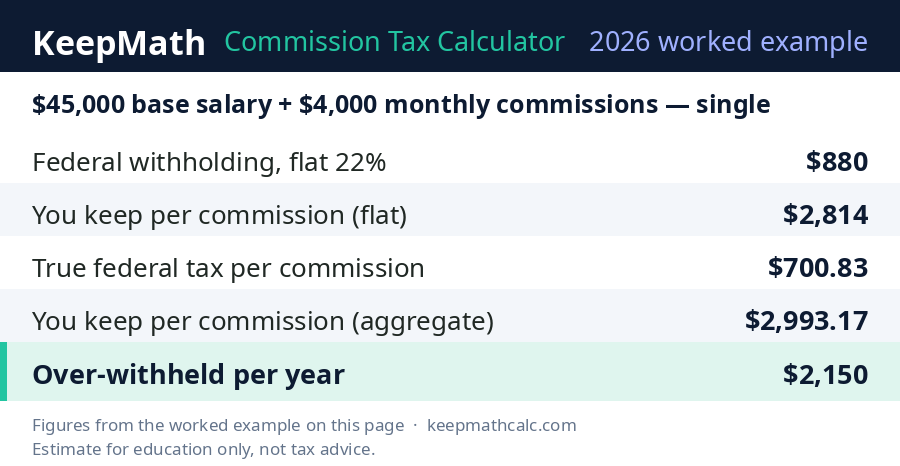
| On a $4,000 commission ($45,000 salary) | $880 | $700.83 |
| When it over-withholds | Whenever your bracket is under 22% | When the commission month is unusually large |
| When it under-withholds | When your bracket is 24% or higher | Rarely, if pay is steady |
| Who chooses | Employer (if commission is separately identified) | Employer — required if not separately identified |
Most payroll systems default to the flat 22% for separately paid commissions because it is simple. The choice is the employer's, not yours — but the result lands in your bank account, which is why the calculator shows both: you can see which method your pay stub is using by comparing the federal withholding line against the two figures.
Worked example: $45,000 base + $4,000 a month
Consider a single salesperson with a $45,000 base salary and steady commissions of $4,000 a month — $48,000 a year, for total income of $93,000. Early in the year, before the Social Security cap matters, each commission check looks like this:
| Line | Flat 22% | Aggregate |
|---|---|---|
| Commission | $4,000.00 | $4,000.00 |
| Federal withholding | $880.00 | $700.83 |
| Social Security (6.2%) | $248.00 | $248.00 |
| Medicare (1.45%) | $58.00 | $58.00 |
| You keep | $2,814.00 | $2,993.17 |
Now the truth. On $93,000 of income, after the $16,100 standard deduction, federal tax is $11,630. On the $45,000 salary alone it would be $3,220. The difference — $8,410 — is the true federal tax on a year of commissions, or $700.83 per commission, a blended 17.5% (the commissions fill the rest of the 12% bracket and spill into 22%). The flat method withholds $880 × 12 = $10,560 across the year, which is $2,150 more than the true $8,410. That $2,150 is not lost; it returns as a refund. But it is $179 a month that could have been in the paycheck instead — the aggregate method, at $700.83, lands almost exactly on the true figure when commissions are steady.
The Social Security cap and late-year commissions
Commissions are wages for Social Security and Medicare, and the two behave differently. Medicare's 1.45% applies to every dollar, with an extra 0.9% on wages beyond $200,000 from one employer. Social Security's 6.2% stops once your year-to-date wages reach $184,500 for 2026. For high-earning salespeople, that cap often arrives in the autumn — and from that point, commission checks suddenly keep 6.2% more.
Say your salary is $170,000 and you earn $30,000 of commissions across the year. Only the first $14,500 of those commissions fits under the $184,500 cap, so Social Security tax on commissions is $899 instead of $1,860 — the last $15,500 of commissions escapes the 6.2% entirely, worth $961. The calculator's "wages already paid this year" box exists for exactly this: fill in your year-to-date wages and watch the Social Security line on the next commission shrink or vanish once the cap is crossed. One caution: if you change employers mid-year, each employer withholds Social Security from zero again, and the excess is claimed back on your return.
Draws against commission
Many sales roles pay a draw — a fixed advance each period that is later recovered from earned commissions. For tax purposes, a draw is simply wages when paid: federal withholding, Social Security and Medicare all apply at payment, exactly as if it were salary. The fact that it might be clawed back does not defer the tax.
The messy part is the clawback. If commissions fall short and you must repay part of a draw, the repayment is dealt with in the year you repay it, not by amending the earlier year. For repayments over $3,000, the claim-of-right rules (IRC §1341) can give relief roughly equal to the tax you paid on the money the first time; smaller repayments may only reduce income in the repayment year, and the old miscellaneous deduction for employee expenses no longer exists. The practical advice is boring but valuable: keep every draw statement and clawback notice, because reconstructing them at tax time from pay stubs alone is painful.
Fixing over-withholding with your W-4
You cannot ask payroll to withhold commissions at 12% instead of 22% — the flat rate is fixed by the IRS. What you can do is reduce withholding on your regular salary so the two balance out across the year. Form W-4 gives you two main levers: Step 3, where credits (dependents, other credits) reduce withholding dollar for dollar, and Step 4(b), where you enter deductions beyond the standard deduction. Claiming an extra deduction amount in Step 4(b) roughly equal to the over-withheld commissions spread across the year is the common approach.
Two warnings. First, run the numbers through the IRS Tax Withholding Estimator before submitting a new W-4 — commission income is variable, and cutting withholding too far in a big year can trigger an underpayment penalty. Second, remember the flip side: if your total income puts you in the 24% bracket or above, the flat 22% under-withholds, and the fix runs the other way — extra withholding in Step 4(c), or quarterly estimated payments using the quarterly estimated tax calculator. The calculator above tells you which side of the line you are on: compare the "true federal tax per commission" against the $880-style flat figure.
Commission tax questions
How are commissions taxed?
Commissions are supplemental wages. If they are paid separately from regular pay or separately identified, federal withholding is a flat 22% (37% once supplemental wages pass $1 million in the year). The commission itself is ordinary income, taxed at your normal bracket when you file.
Why is so much tax taken from my commission check?
Because the flat 22% federal withholding is added to Social Security (6.2%), Medicare (1.45%) and any state withholding. If your real federal bracket is 12%, the 22% over-withholds by 10 points on every commission — the excess comes back as a refund, or you can offset it on your W-4.
What is the aggregate method for commissions?
Instead of the flat 22%, the employer adds the commission to your regular pay for the period and withholds on the combined amount as if it were your normal pay rate all year. It tracks your real bracket more closely, so for many commission earners it withholds less than the flat rate.
Do commissions count toward the Social Security wage base?
Yes — commissions are wages for Social Security purposes. The 6.2% tax runs until your wages for the year hit $184,500 (the 2026 ceiling); high earners often cross it in the autumn, and later commission checks keep that 6.2%.
How are draws against commission taxed?
A draw is taxed as wages when it is paid, with normal withholding, even though it is an advance against future commissions. If you later have to repay a draw, the repayment is handled in the year you repay it — the tax rules depend on the amount, so keep records of every draw and clawback.
Can I lower the withholding on my commissions?
You cannot change the flat 22% itself, but you can reduce withholding on your regular pay by adjusting your W-4 (for example claiming credits in Step 3 or a deduction in Step 4), which offsets the over-withholding across the year. Use the IRS Tax Withholding Estimator first — cutting too far risks an underpayment penalty.
What is California's withholding rate on commissions?
6.6%. California withholds bonuses and stock options at 10.23%, but other supplemental wages — commissions, overtime, severance — at 6.6% when paid separately. Enter 6.6 in the state rate box to model it.
How this page was checked
Federal treatment follows IRS Publication 15 (supplemental wages, 22% flat rate, 37% over $1 million, aggregate method) and Revenue Procedure 2025-32 for the 2026 brackets and standard deduction. The 2026 Social Security wage ceiling is $184,500 (SSA). California's 6.6% commission withholding rate is from the EDD's 2026 California Employer's Guide (DE 44). The worked example was recomputed by hand: true federal tax on $48,000 of commissions over a $45,000 salary is $8,410.
Sources and review
Last reviewed November 2026. The withholding rules are from IRS Publication 15; brackets and the standard deduction use the 2026 figures in Revenue Procedure 2025-32.
Other calculators to try
- Bonus tax calculator for one-off bonuses under the same supplemental rules
- Paycheck with bonus calculator when extra pay lands inside your regular check
- California bonus tax calculator for the 10.23% state rate and SDI
- Quarterly estimated tax calculator if commissions leave you under-withheld
See what you keep after tax.
Try another calculator