Example numbers shown. Tap a box to type your own.
Full breakdown
| Federal withholding (22% flat) | |
| California withholding | |
| Social Security (6.2% to $184,500) | |
| Medicare (1.45% + 0.9% over $200,000) | |
| California SDI (1.3%, no cap) | |
| Total withheld | |
| You keep now | |
| True federal tax on the bonus | |
| True California tax on the bonus | |
| True total tax on the bonus | |
| You keep after filing | |
| Refund back (or extra owed) |
Withholding uses the 2026 federal 22% supplemental rate (37% over $1 million) and the EDD's California rates: 10.23% on a separately paid bonus, aggregate withholding inside regular pay, plus 1.3% SDI. The "true tax" lines use the 2026 federal brackets and the latest published FTB schedules (tax year 2025).
Estimate for education only, not tax advice.
Key takeaways
- California withholds bonuses at a flat 10.23% when paid separately — on top of the federal 22%.
- SDI takes another 1.3% with no wage cap. The typical combined withholding is 41.18% of the bonus.
- Most Californians are in the 9.3% bracket or lower, so the 10.23% state withholding overpays and part comes back.
- A bonus inside your regular check is withheld by the aggregate method in California, which can take even more upfront.
- The bonus itself is ordinary income in both systems. Withholding is an estimate; the return settles the difference.
California taxes bonuses twice
Everywhere in the US, a bonus faces federal withholding at a flat 22%. California adds a second flat rate of its own: 10.23%, set by the Employment Development Department (EDD) for bonuses and stock options paid separately from regular wages. Stack the two together with Social Security (6.2%), Medicare (1.45%) and California SDI (1.3%), and the typical California bonus check loses 41.18% to withholding before you see it. On a $5,000 bonus, that is $2,059 gone on day one.
None of those percentages is your tax rate. California taxes the bonus as ordinary income under its own brackets — 1% up to 12.3%, plus 1% over $1 million — and the federal government does the same under its brackets. Withholding is just the prepayment, and because California's flat 10.23% sits above the 9.3% bracket where most bonus earners actually land, the state usually owes you money at filing time. This calculator shows both layers: what is withheld now, and what the bonus truly costs once your salary and brackets are taken into account. For the federal-only view, see the bonus tax calculator.
Separate check vs same check: the 10.23% rule
California's flat 10.23% rate applies when the bonus comes on a standalone check, or is separately identified within the same check. If the bonus is folded into your regular paycheck without being identified separately, California requires the aggregate method instead: the bonus is added to your regular wages for the period and withholding is computed on the combined amount using the EDD's withholding schedules. The aggregate method annualizes the big check, so it typically withholds more than 10.23% of the bonus — sometimes much more.
Federally, the picture is similar but not identical: the IRS allows the flat 22% on supplemental wages that are separately identified, and the aggregate method otherwise. In practice, most employers identify bonuses separately and use the flat rates on both levels, which is why the 22% + 10.23% combination is the one most Californians see. The calculator's "how is the bonus paid" switch models both California treatments so you can match it to your pay stub. Either way, remember the final tax is identical — only the timing of the prepayment changes.
Worked example: $60,000 salary, $5,000 bonus
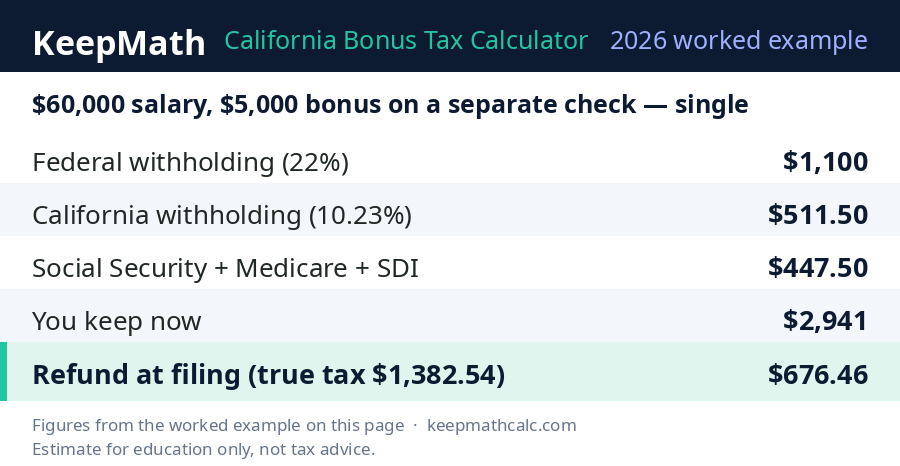
Take a single filer in California on a $60,000 salary who receives a $5,000 bonus on a separate check, early in the year, with no dependents. Here is the check, then the truth.
| Line | Withheld now | True tax |
|---|---|---|
| Federal income tax | $1,100.00 (22%) | $600.00 (12%) |
| California income tax | $511.50 (10.23%) | $335.04 (6.7%) |
| Social Security (6.2%) | $310.00 | $310.00 |
| Medicare (1.45%) | $72.50 | $72.50 |
| California SDI (1.3%) | $65.00 | $65.00 |
| Total | $2,059.00 | $1,382.54 |
| You keep | $2,941.00 | $3,617.46 |
The bonus takes total income from $60,000 to $65,000. Federally that slice sits in the 12% bracket, so the real federal tax on the bonus is $600 — barely half the $1,100 withheld. In California, after the $5,706 standard deduction, the bonus spans the 6% and 8% brackets and the $153 exemption credit, for a real state tax of $335.04 against $511.50 withheld. Payroll taxes are exact either way. Total refund at filing: $676.46, of which $500 is federal and $176.46 is California's. The lesson generalizes: the lower your salary, the more of the flat withholding is really an interest-free loan to the government.
SDI: the deduction with no cap
The 1.3% line on a California pay stub is State Disability Insurance, the employee-funded program that pays short-term disability benefits and Paid Family Leave. Two things make it different from the other deductions. First, it is not an income tax and it is not refundable at filing — the 1.3% is simply gone, funding the insurance pool. Second, since January 1, 2024, when SB 951 removed the taxable wage limit, SDI applies to every dollar of wages with no annual maximum. Before 2024, high earners stopped paying SDI partway through the year; now a bonus in December is charged at the same 1.3% as one in January.
The 2026 rate is 1.3%, up from 1.2% in 2025. On a $5,000 bonus that is $65; on a $50,000 bonus, $650. It also applies to RSU vests and commissions — all California wages — which is why it appears on the California RSU calculator too. If your employer has an approved voluntary plan instead of SDI, the line may be labeled differently, but the calculator assumes the standard state program.
Where your bonus really lands
The table below shows the true tax on a $5,000 bonus at different salary levels for a single filer — the number the flat withholding is trying, roughly, to guess. California's 10.23% withholds $511.50 in every row; the federal 22% withholds $1,100.
| Salary | True federal tax on $5,000 bonus | True California tax on $5,000 bonus | Withholding vs true tax |
|---|---|---|---|
| $40,000 | $600 (12%) | $200 (4%) | $811.50 comes back |
| $60,000 | $600 (12%) | $335 (6.7%) | $676.46 comes back |
| $80,000 | $1,100 (22%) | $465 (9.3%) | $46.50 comes back |
| $100,000 | $1,100 (22%) | $465 (9.3%) | $46.50 comes back |
| $150,000 | $1,200 (24%) | $465 (9.3%) | $53.50 extra owed |
| $250,000 | $1,600 (32%) | $477 (9.5%) | $465.50 extra owed |
| $400,000 | $1,750 (35%) | $515 (10.3%) | $653.50 extra owed |
Two patterns stand out. California's flat rate over-withholds at every salary up to about $400,000, because the 9.3% bracket covers taxable income from $72,724 to $371,479 for single filers — a huge range — and 9.3% is below 10.23%. The federal flat rate, by contrast, flips from over- to under-withholding around the $150,000 salary mark, where the 24% bracket begins. Past that point the federal shortfall grows quickly, and at $250,000-plus salaries the combined gap is worth covering with extra W-4 withholding or an estimated payment.
When California gives money back
California refunds the difference automatically when you file Form 540: the 10.23% withheld is credited against your actual California tax, computed on your full income with the standard deduction and exemption credits. You do not need to claim anything special. The refund is bigger the further your marginal rate sits below 10.23% — a bonus earner in the 6% bracket gets back roughly 4.2 cents of every bonus dollar from the state alone.
The exception is the top of the income scale. California's brackets reach 10.3% at $371,479 of taxable income (single), 11.3% at $445,771 and 12.3% at $742,953, plus the 1% Mental Health Services Tax over $1 million. In those brackets the 10.23% withholding falls short, and the exemption credits also phase out (starting at $252,203 of AGI for single filers), which raises the effective rate on a bonus a little further. If your salary plus bonus puts you in that territory, treat the bonus withholding as a down payment, not the bill — and consider the quarterly estimated tax calculator for the federal side, where the same problem is larger.
California bonus questions
How much tax is taken from a bonus in California?
On a typical bonus, 41.18% comes off the top: 22% federal, 10.23% for California, 6.2% Social Security, 1.45% Medicare and 1.3% SDI. Treat that as a deposit, not the bill — your actual federal and state brackets decide the final tax, and any difference is settled on your return.
Why is California bonus withholding 10.23%?
California's EDD publishes flat rates for supplemental pay in its Employer's Guide (DE 44). Bonuses and stock options on a standalone check are withheld at 10.23%; other supplemental pay, like commissions and overtime, at 6.6%.
What is the 1.3% SDI deduction on my bonus?
It funds California's disability and Paid Family Leave programs. The 2026 employee rate is 1.3%, and the old taxable wage ceiling was removed from January 1, 2024, so the charge applies to the full bonus at any income level.
Does California tax bonuses at a higher rate?
No. California taxes a bonus as ordinary income at the same brackets as salary — 1% to 12.3%, plus 1% over $1 million. The 10.23% is only withholding. If your California bracket is 9.3%, part of that withholding comes back as a refund.
Does it matter if the bonus is in my regular check?
For California withholding, yes. When a bonus arrives on its own check (or is separately identified), California withholds at the flat 10.23%. Paid inside your regular check without separate identification, California requires the aggregate method — the bonus is added to your regular wages and withheld on the combined amount. The final tax is the same either way.
Will I get a California refund on my bonus?
Usually, if your California marginal rate is below 10.23% — which covers everyone in the 9.3% bracket or lower, meaning most bonus earners. At very high incomes the 10.3%, 11.3% and 12.3% brackets flip it the other way and a small balance can be due.
Are bonuses subject to Social Security tax?
Yes — a bonus counts as wages for Social Security and Medicare. Social Security's 6.2% ends when your annual wages pass $184,500 (the 2026 limit); Medicare's 1.45% never stops.
How this page was checked
State figures were cross-checked with the EDD's Employer's Guide for 2026 (DE 44, Rev. 52), which sets the 10.23% bonus rate, the 6.6% rate for other supplemental pay, and SDI at 1.3% (the wage ceiling was removed by SB 951 in 2024). Federal rates follow IRS Publication 15 and Revenue Procedure 2025-32, and the 2026 Social Security wage limit is $184,500 (SSA). California's brackets, standard deduction and credits use the FTB's 2025 tables, including the high-income credit phase-out. Every number in the worked example and salary table was calculated independently.
Sources and review
Last reviewed November 2026. State withholding comes from the EDD's 2026 Employer's Guide; California brackets and credits are the FTB's 2025 schedules.
Other calculators to try
- Bonus tax calculator for the federal view in any state
- Paycheck with bonus calculator when the bonus lands in your regular check
- California RSU tax calculator for stock vesting in California
- Commission tax calculator if the extra pay is commission (6.6% CA withholding)
See what you keep after tax.
Try another calculator