Example numbers shown. Tap a box to type your own.
Full breakdown
| Federal withholding (22% / 37% over $1M) | |
| California withholding (10.23%) | |
| Social Security (6.2% to $184,500) | |
| Medicare (1.45% + 0.9% over $200,000) | |
| California SDI (1.3%, no cap) | |
| Total withheld at vest | |
| Shares vesting | |
| Shares sold to cover | |
| Shares you keep | |
| True federal tax on the vest | |
| True California tax on the vest | |
| True total tax on the vest | |
| Still owed at filing (or refund) |
Withholding uses the 2026 federal supplemental rates and the EDD's 10.23% California rate plus 1.3% SDI. The "true tax" lines use the 2026 federal brackets and the latest published FTB schedules (tax year 2025), with the California standard deduction and exemption credits. Estimates only — your full return decides.
Estimate for education only, not tax advice.
Key takeaways
- RSUs are taxed as wages the day they vest — in California as well as federally. There is no special RSU rate.
- California withholds a flat 10.23% on stock-compensation vests, plus 1.3% SDI with no wage cap.
- Federal withholding is 22% (37% over $1 million of supplemental wages), which under-withholds if your bracket is 24% or higher.
- California's real brackets top out at 12.3%, plus 1% over $1 million — so the 10.23% withholding overpays for most people in the 9.3% bracket.
- When you sell later, California taxes the gain at regular rates. There is no California capital-gains discount.
What happens on vest day in California
An RSU is a promise of shares, and the tax clock starts when the promise is kept. On the vest date the shares become yours, and the IRS and California both treat their market value that day as wages — the same as if your employer had handed you that amount in cash salary. It goes on your W-2, it is taxed at ordinary rates, and it is subject to payroll tax. Nothing about the grant date or the price when the RSUs were promised matters for this first tax hit.
Because the income arrives as shares rather than cash, your employer has to collect the tax from the shares themselves. Most California employers use sell-to-cover: enough shares are sold at vest to pay the withholding, and the rest land in your brokerage account. What is withheld is an estimate built from flat rates, and — this is the part that catches people — the flat rates rarely match your real brackets, in either direction. The calculator separates the two numbers: what comes out on vest day, and what the vest truly costs once your full year is known.
The five deductions from a vest
A California RSU vest is one of the most heavily withheld payments in US payroll, because two governments and three payroll taxes all take a slice at once:
| Deduction | 2026 rate on the vest | Set by |
|---|---|---|
| Federal income tax | 22% flat; 37% on supplemental wages over $1M in the year | IRS Publication 15 |
| California income tax | 10.23% flat for bonuses and stock options | EDD, California Employer's Guide (DE 44) |
| Social Security | 6.2% until year-to-date wages reach $184,500 | SSA wage base |
| Medicare | 1.45% on all wages; +0.9% withheld on wages over $200,000 from one employer | IRS / SSA |
| California SDI | 1.3% on all wages — no cap since January 1, 2024 | EDD (SB 951 removed the cap) |
Add the standard rates together and the combined withholding on a typical vest is 41.18% — 22 + 10.23 + 6.2 + 1.45 + 1.3 — before any 0.9% additional Medicare tax. That is the number that shocks people on vest day. It is not your tax rate; it is a stack of prepayments, and two of the five pieces (federal and California income tax) are trued up when you file.
Worked example: $120,000 salary, $30,000 vest
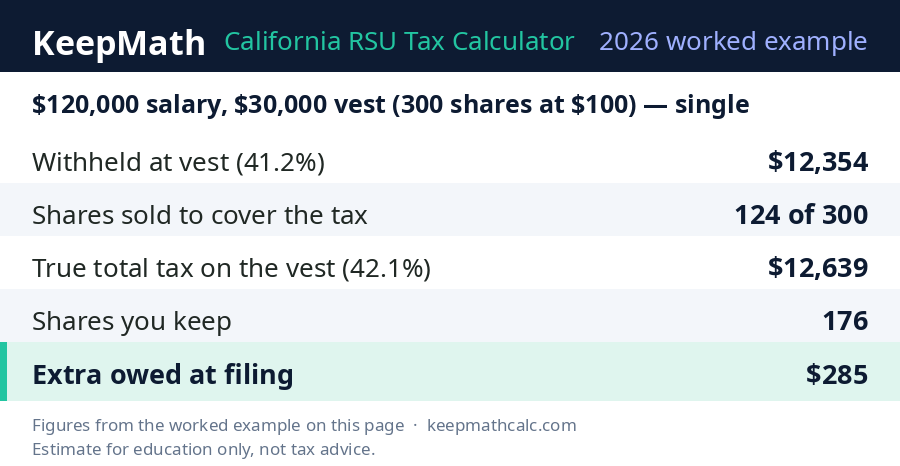
Take a single filer in California with a $120,000 salary whose RSUs vest at $30,000 — 300 shares at $100 — partway through the year, with $60,000 of wages already paid. Here is vest day, then the real bill.
| Line | Withheld at vest | True tax on the vest |
|---|---|---|
| Federal income tax | $6,600 (22%) | $7,164 (23.9%) |
| California income tax | $3,069 (10.23%) | $2,790 (9.3%) |
| Social Security | $1,860 | $1,860 |
| Medicare | $435 | $435 |
| California SDI | $390 | $390 |
| Total | $12,354 | $12,639 |
On vest day, $12,354 is withheld, so 124 of the 300 shares are sold to cover and 176 shares arrive in the account. At filing time the picture shifts a little: the vest pushed this filer's income from $120,000 to $150,000, where the federal marginal rate is mostly 24%, so the real federal tax on the vest is $7,164 — $564 more than the 22% withheld. California goes the other way: the whole vest sits in the 9.3% bracket, so the real California tax is $2,790, which is $279 less than the 10.23% withheld. Net result: $285 still owed with the return. Neither flat rate was "wrong" — they are simply not your brackets, and the calculator shows you both gaps before April does.
Why 10.23% is not your California rate
California's 10.23% is a withholding shortcut, not a tax bracket. Your actual California tax comes from the FTB rate schedules — nine brackets from 1% to 12.3%, plus a 1% Mental Health Services Tax on taxable income over $1 million, for a 13.3% top rate. Most RSU recipients in tech land in the 9.3% bracket, which means California withholds about a point too much on every vest and refunds it later. Very high earners in the 11.3% or 12.3% brackets are under-withheld instead.
| Rate | Single / MFS taxable income | Married filing jointly | Head of household |
|---|---|---|---|
| 1% | $0 – $11,079 | $0 – $22,158 | $0 – $22,173 |
| 2% | $11,079 – $26,264 | $22,158 – $52,528 | $22,173 – $52,530 |
| 4% | $26,264 – $41,452 | $52,528 – $82,904 | $52,530 – $67,716 |
| 6% | $41,452 – $57,542 | $82,904 – $115,084 | $67,716 – $83,805 |
| 8% | $57,542 – $72,724 | $115,084 – $145,448 | $83,805 – $98,990 |
| 9.3% | $72,724 – $371,479 | $145,448 – $742,958 | $98,990 – $505,208 |
| 10.3% | $371,479 – $445,771 | $742,958 – $891,542 | $505,208 – $606,251 |
| 11.3% | $445,771 – $742,953 | $891,542 – $1,485,906 | $606,251 – $1,010,417 |
| 12.3% | Over $742,953 | Over $1,485,906 | Over $1,010,417 |
These are the FTB's 2025 schedules — the latest published when this page was checked — applied after California's own standard deduction ($5,706 single, $11,412 joint or head of household) and exemption credits ($153 per person, $306 joint, $475 per dependent, phased out at higher incomes). The calculator uses exactly these figures for its "true California tax" line, so you can compare the 10.23% withheld against the bracket your vest actually lands in.
Sell-to-cover: how the share count works
Under sell-to-cover, the math is blunt: total withholding divided by the vest-day share price, rounded up to whole shares. In the worked example, $12,354 ÷ $100 = 123.54, so 124 shares are sold and 176 remain. The small overage from rounding up is typically refunded in cash or applied against the tax. The shares you keep have a cost basis equal to the vest-day price — $100 in the example — because you have already paid income tax on that value.
Two practical consequences follow. First, the share count is set by the withholding rates, not your real tax, so a vest in a high-withholding setup (for example, after the $1 million supplemental threshold, when federal withholding jumps to 37%) sells noticeably more shares. Second, sell-to-cover is not a decision to sell your investment — it is a tax payment mechanism. Whether to hold or sell the remaining 176 shares is a separate choice, with separate tax consequences covered below.
High pay: the $1M rule, Social Security cap and extra Medicare
Three thresholds change the math as pay rises. First, once your supplemental wages for the year — bonuses plus RSU vests and similar payments — pass $1 million, federal withholding on the excess is a mandatory 37%, not 22%. A large vest late in a big year can therefore lose well over half its value to withholding on the day. Second, Social Security tax stops at $184,500 of wages for 2026: a vest that lands after your salary has crossed the cap keeps the 6.2% entirely, which is why the calculator asks for wages already paid. Third, Medicare adds 0.9% on pay above $200,000 from a single employer (the tax itself applies over $200,000 single / $250,000 joint), and California SDI at 1.3% has no cap at all — it takes its slice of a $10,000 vest and a $1,000,000 vest alike.
For a sense of scale: a $300,000 vest for someone already past the Social Security cap, in the 35% federal and 11.3% California brackets, faces roughly 22% federal withholding against a 35% real rate — a federal shortfall near $39,000 on that one vest, partly offset by California over-withholding. That is the situation where a quarterly estimated payment or extra W-4 withholding stops being optional. The quarterly estimated tax calculator sizes the safe payment.
Selling later: no capital-gains break
After vest day, the shares are simply an investment you own, with a basis of the vest-day price. Sell them the same day and there is essentially no further tax — no gain, no loss. Hold them and the price moves: federally, a gain after more than a year gets the preferential 0%, 15% or 20% long-term capital-gains rates. California does not play along. California taxes capital gains as ordinary income at your regular rates, up to 13.3% with the Mental Health Services Tax, however long you held the shares. A gain that costs 15% federally can cost 9.3% or more in California on top.
Losses cut the other way: sell below your vest-day basis and you have a capital loss, usable against gains and up to $3,000 a year against other income, with the rest carried forward — under both federal and California rules. The one trap to avoid is the wash sale: buying the same stock back within 30 days of a loss sale defers the loss. None of this changes the vest-day tax, which is settled as wages no matter what the stock does afterward.
California RSU questions
What tax rate applies to RSUs in California?
RSU income is ordinary wages in California, just as it is federally. At vest, your employer withholds 22% federal and 10.23% California income tax, plus Social Security, Medicare and 1.3% SDI. Your real rates are your federal and California marginal brackets, settled when you file.
Why is California RSU withholding 10.23%?
The California EDD sets flat withholding rates for supplemental wages paid separately from regular pay: 10.23% for bonuses and stock options, and 6.6% for other supplemental wages like commissions. RSU vests are withheld at the 10.23% stock-compensation rate.
Do RSUs pay California SDI?
Yes. RSU vest income is wages for California State Disability Insurance. The 2026 SDI rate is 1.3% and, since January 1, 2024, there is no wage cap — every dollar of the vest is charged, however much you have already earned.
How many shares will be sold to cover taxes?
Under sell-to-cover, your employer sells enough shares to pay the total withholding. Divide the total withheld by the share price at vest and round up: $12,354 withheld at $100 a share means 124 shares sold. The calculator does this for your numbers.
Will I owe more tax after my RSUs vest?
Often a little, in one direction or the other. Federal withholding at 22% falls short if your bracket is 24% or higher, while California's 10.23% over-withholds if your California bracket is 9.3%. In the worked example the two mostly cancel, leaving $285 to pay at filing.
Are RSUs taxed again when I sell the shares?
Only on the change in value after vesting. Your cost basis is the vest-day price, already taxed as wages. Sell later for more and the gain is a capital gain federally — but California has no preferential capital-gains rate, so the gain is taxed at your regular California rates up to 13.3%.
What if I leave California before my RSUs vest?
California taxes income from California sources even after you move. RSU income is generally sourced by where you worked during the vesting period, so part of a vest can remain California-taxable after a move. The rules are detailed — get advice before a move with unvested RSUs.
How this page was checked
Withholding rates were verified against the EDD's 2026 California Employer's Guide (DE 44, Rev. 52): 10.23% for bonuses and stock options, 6.6% for other supplemental wages, SDI 1.3% with the wage cap removed by SB 951. Federal brackets and the standard deduction are the 2026 figures in IRS Revenue Procedure 2025-32, and the Social Security wage limit for 2026 is $184,500 (SSA). California's true-tax line uses the FTB 2025 rate schedules, standard deduction and exemption credits. All worked-example figures were verified manually.
Sources and review
Reviewed November 2026. Withholding and SDI rates are from the EDD's 2026 Employer's Guide (DE 44); the state brackets and exemption credits follow the FTB's 2025 tables.
Other calculators to try
- RSU tax calculator for the federal-only view of a vest
- California bonus tax calculator for a cash bonus in California
- Capital gains tax calculator for selling shares after vesting
- Quarterly estimated tax calculator if a vest leaves you under-withheld
See what you keep after tax.
Try another calculator